
The Man Who Drove on Schumacher’s Tires

![[object Object]](https://api.hedonistmagazine.net/storage/images/2026/06/18d7db8d-26a7-4e2e-b1d4-eec5bf734bb7.webp)
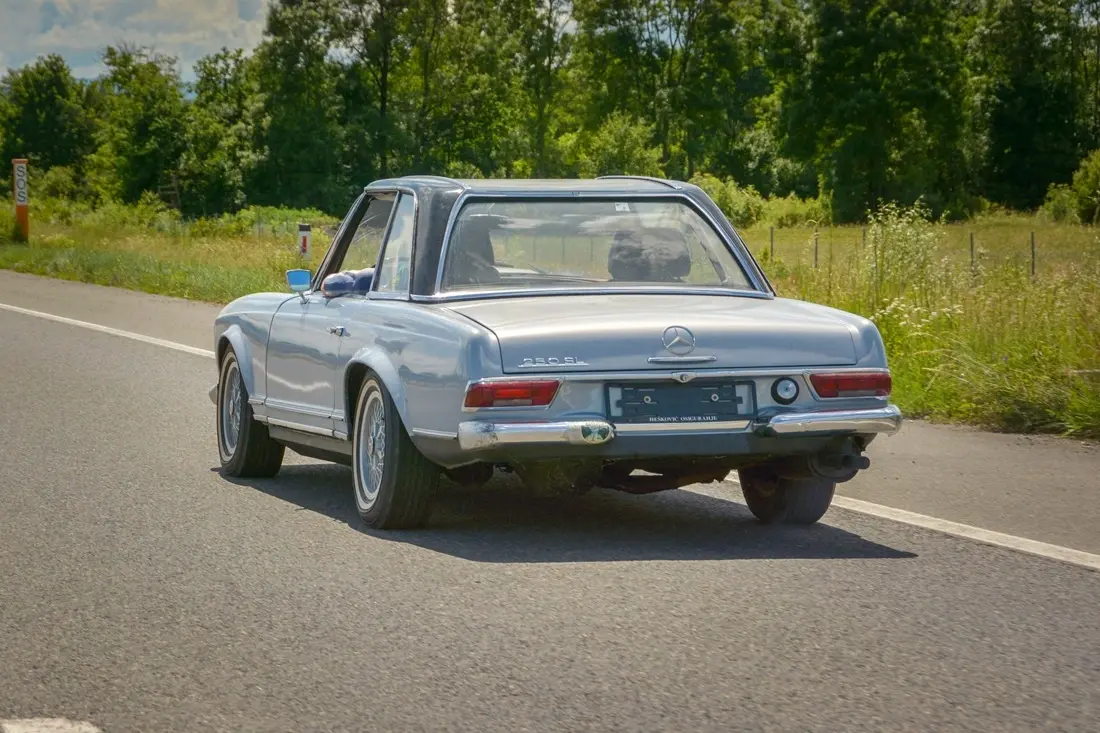
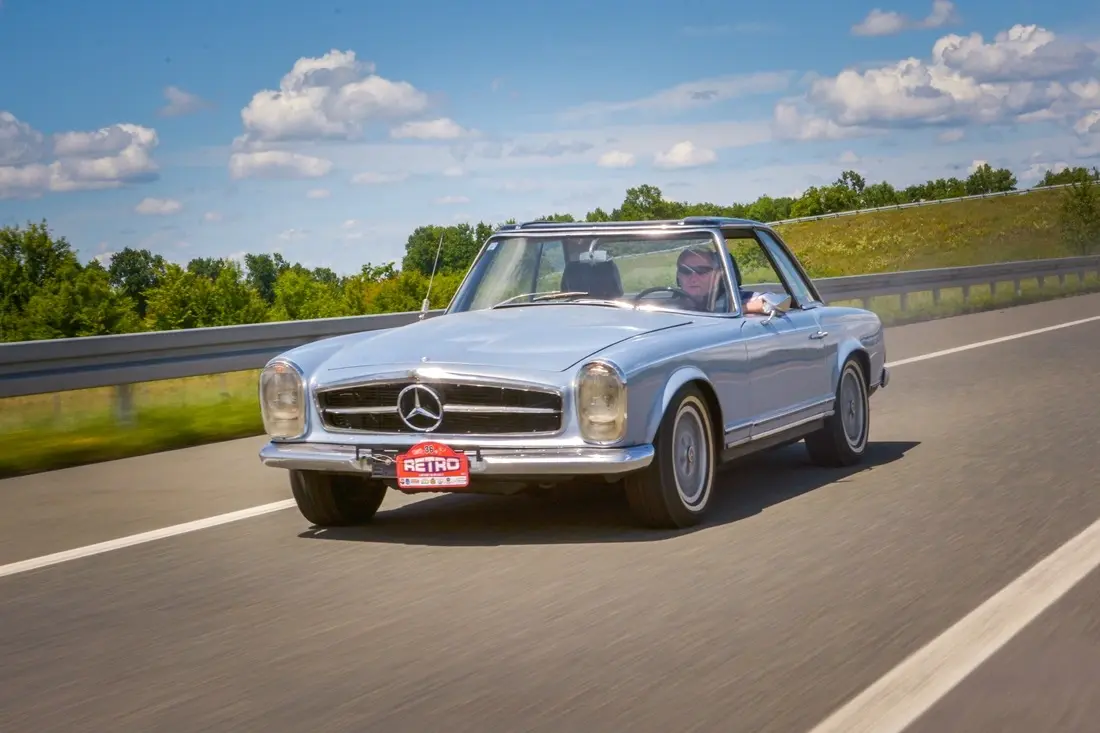
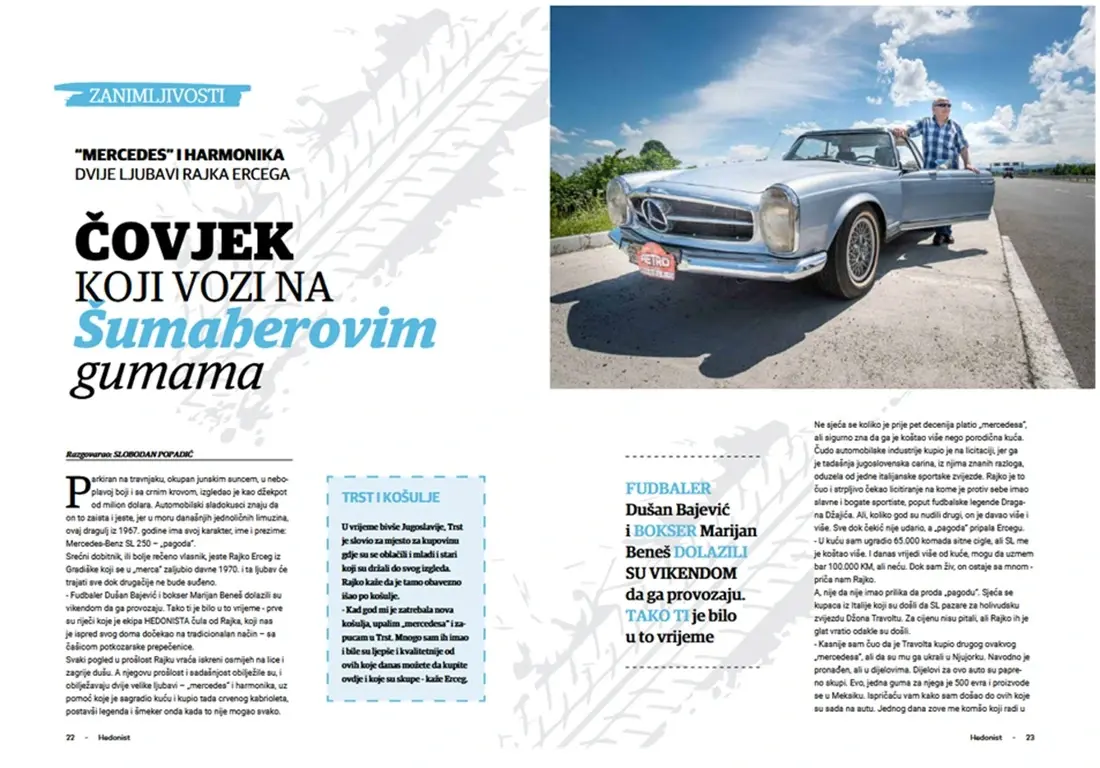
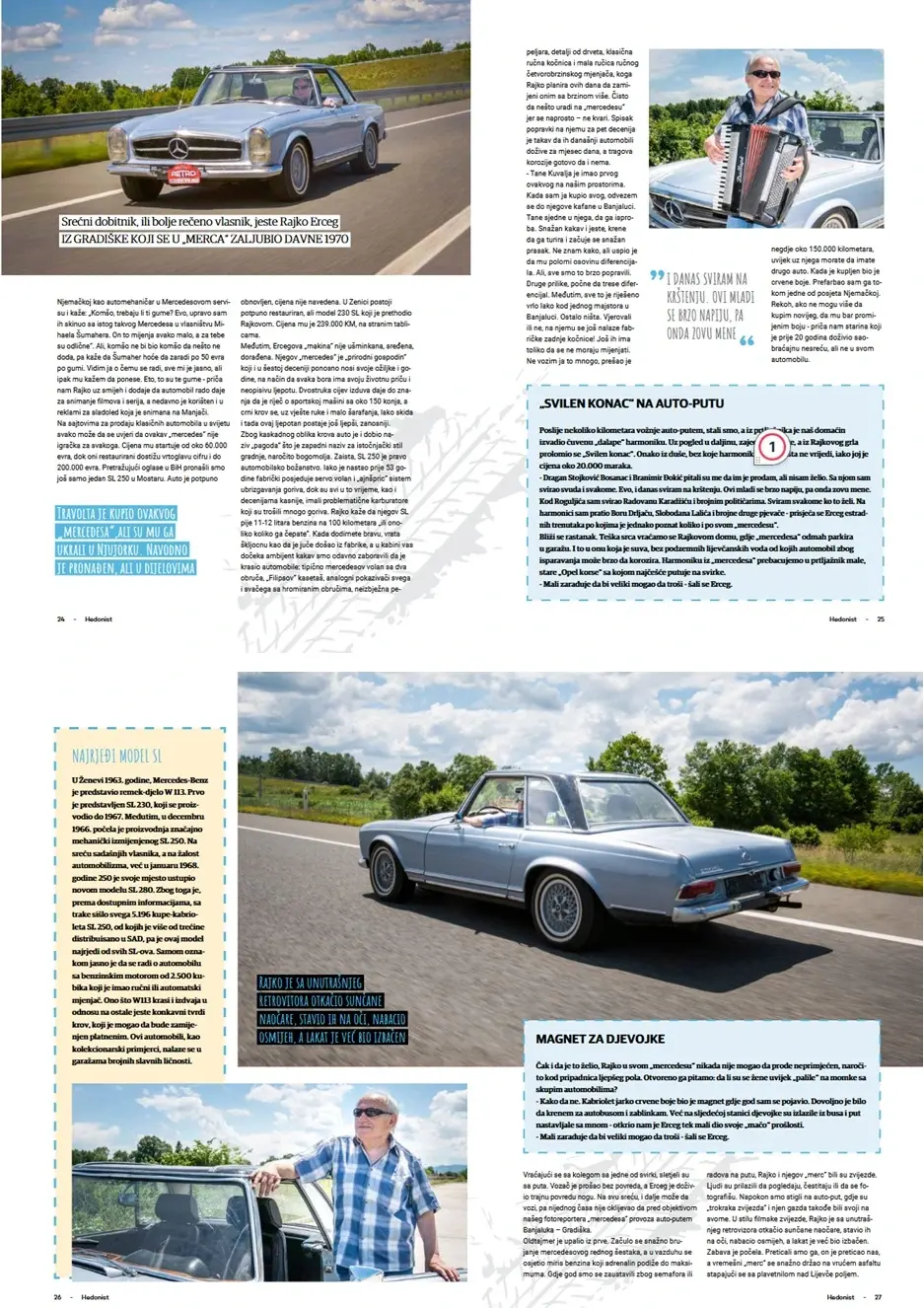
Parked on a grassy lawn, bathed in the June sun, painted sky blue with a black roof, it looked like a million-dollar jackpot. Automotive connoisseurs know that it truly is one. In a sea of today’s uniform sedans, this gem from 1967 has character, a name, and a surname: the Mercedes-Benz 250 SL “Pagoda.”
The proud owner of this remarkable automobile was Rajko Erceg from Gradiška, who fell in love with the car back in 1970 and remained devoted to it until his passing in 2021. A year before that, the HEDONIST team spent hours talking with Rajko. This is a republication of that story, exactly as it was originally told.
“Football legend Dušan Bajević and boxer Marijan Beneš used to come on weekends just to take it for a drive. That’s how things were back then,” were the first words Rajko greeted us with as he welcomed the HEDONIST team outside his home traditionally – with a glass of homemade plum brandy from the Kozara region.
Time had long since turned his hair white, but every glance into the past brought a sincere smile to his face. His life was shaped by two great loves: his Mercedes and his accordion. With music, he built a house and bought the then-red convertible that made him both a local legend and a gentleman at a time when not everyone could afford such status.
Rajko could no longer remember how much he paid for the Mercedes five decades ago, but he knew one thing for certain: it cost more than his family home.
He bought the car at an auction after Yugoslav customs authorities confiscated it from an Italian sports celebrity for reasons known only to them. When Rajko heard about the auction, he waited patiently. Among the bidders were wealthy and famous athletes, including football icon Dragan Džajić. But no matter how much they offered, Rajko always bid higher. Eventually, the hammer fell, and the Pagoda became his.
“I used 65,000 small bricks to build my house, but the SL cost even more. Even today, it’s worth more than the house. I could easily get at least 100,000 marks for it, but I won’t sell. As long as I’m alive, it stays with me,” Rajko said.
And opportunities to sell it certainly existed.
He recalled a group of buyers from Italy who arrived hoping to purchase the SL for Hollywood star John Travolta. They never even asked about the price, but Rajko politely sent them back home empty-handed.
“Later, I heard Travolta bought a long-wheelbase Mercedes similar to this one, but it was stolen in New York. Apparently, it was eventually found - in pieces. Spare parts for these cars are incredibly expensive. One tire alone costs around 500 euros and is made in Mexico. Let me tell you how I got the tires currently on the car.
One day, my neighbor, who worked as a mechanic at a Mercedes dealership in Germany, called me and said: ‘Neighbor, do you need tires? I’ve just taken them off the same Mercedes that Michael Schumacher owned. He changes them all the time, and these are still excellent for you.’
Of course, he added that Schumacher wanted fifty euros per tire. I knew exactly what was going on, but I told him to bring them anyway. Those are the tires you see on the car today.”
Rajko laughed as he told the story, adding that he frequently lent the car for movies and television productions. It had even recently appeared in an ice cream commercial filmed on Mount Manjača.
Worth a Small Fortune
Anyone browsing classic car marketplaces can quickly discover that a Mercedes like this is not for everyone. Prices start around €60,000, while fully restored examples can exceed €200,000.
At the time, searches through listings in Bosnia and Herzegovina revealed only one other SL 250, located in Mostar. Another fully restored predecessor, the 230 SL, was for sale in Zenica for nearly 239,000 KM.
Yet Rajko’s Pagoda was different.
It wasn’t over-restored or polished into perfection. It was a naturally elegant gentleman, proudly carrying the marks of six decades. Every scratch seemed to tell a story.
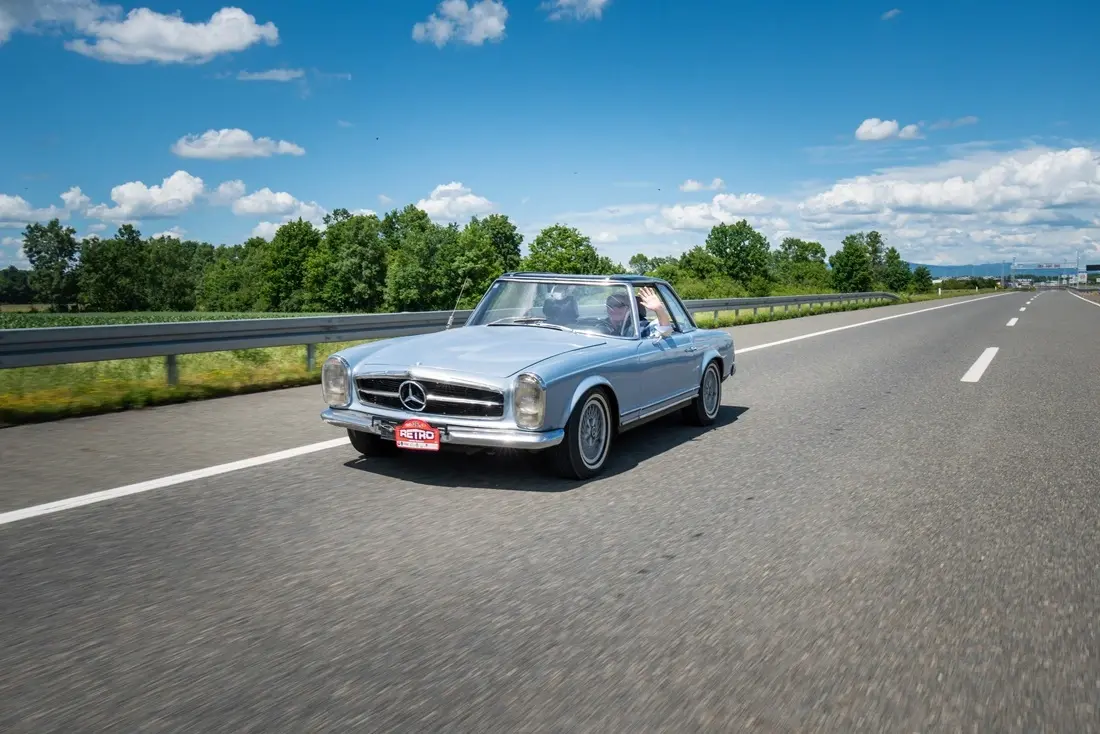
The twin exhaust pipes reminded observers that this was a sports car with around 150 horsepower. The distinctive hardtop, which could easily be removed, gave the car its famous nickname “Pagoda,” inspired by the curved roofs of East Asian temples.
An Automotive Masterpiece
Even though it was more than half a century old, the SL 250 came factory-equipped with power steering and a fuel injection system - features far ahead of many competitors of its era, who still relied on carburetors.
“My SL uses about 11 to 12 liters per 100 kilometers - or more if you push it,” Rajko joked.
When you touched the door handle, it clicked shut as if it had just left the factory.
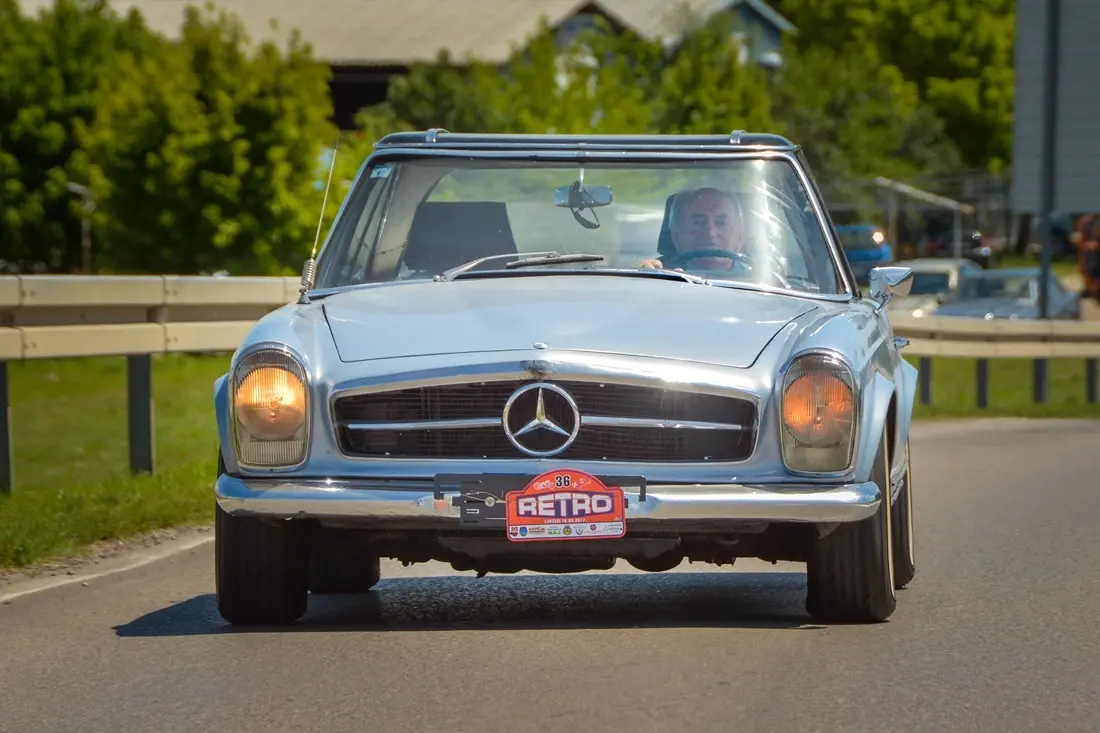
Inside, the cabin offered a glimpse into a forgotten automotive world: the classic Mercedes steering wheel with two spokes, a Philips cassette player, chrome-ringed analog gauges, wood trim, a traditional handbrake, and a small four-speed manual gear lever.
The list of repairs performed over five decades was astonishingly short.
“Believe it or not, it still has the original rear brakes from the factory,” Rajko proudly explained.
The Highway and “Silken Thread”
Although he suffered a serious traffic accident two decades earlier while traveling in another vehicle, Rajko never lost his passion for driving.
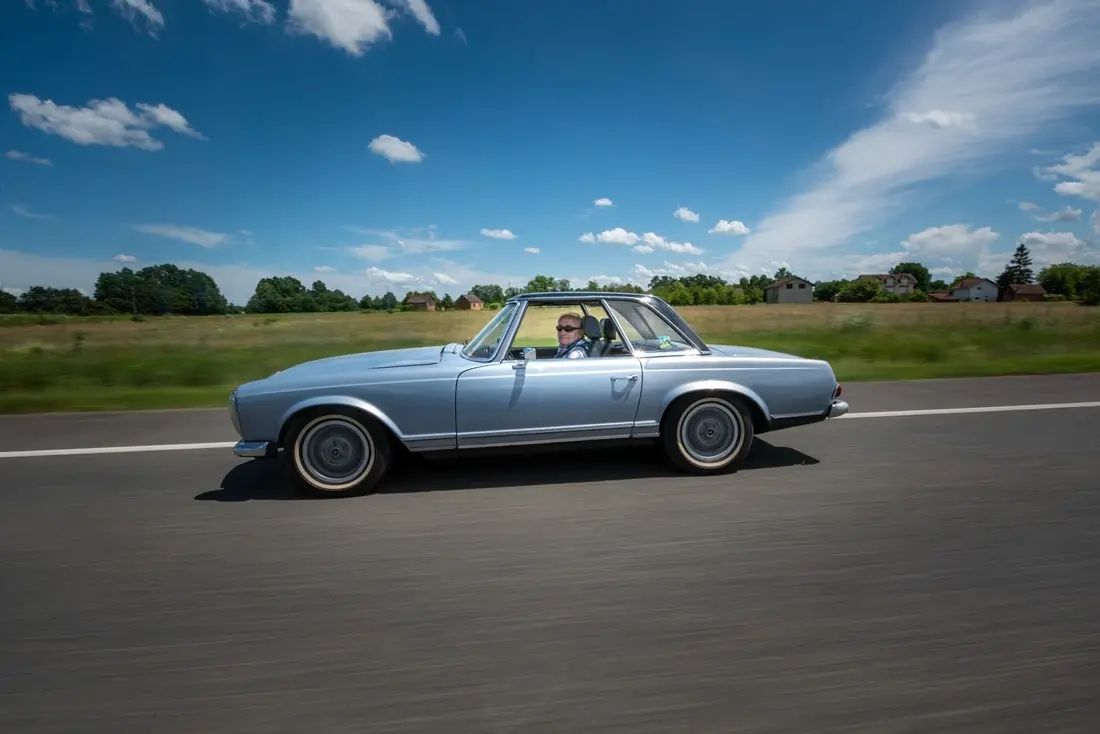
When the HEDONIST photographer asked him to take the Mercedes onto the Banja Luka–Gradiška motorway, he agreed without hesitation.
The old-timer started instantly.
The deep growl of the inline-six engine filled the air, accompanied by the unmistakable scent of gasoline. Everywhere they stopped, Rajko and his Mercedes became instant attractions. People approached to admire the car, take photographs, and offer compliments.
On the motorway, the three-pointed star felt completely at home.
Like a movie star, Rajko clipped on his sunglasses, smiled, rested his elbow on the window frame, and enjoyed the drive.
The Accordion That Built a Life
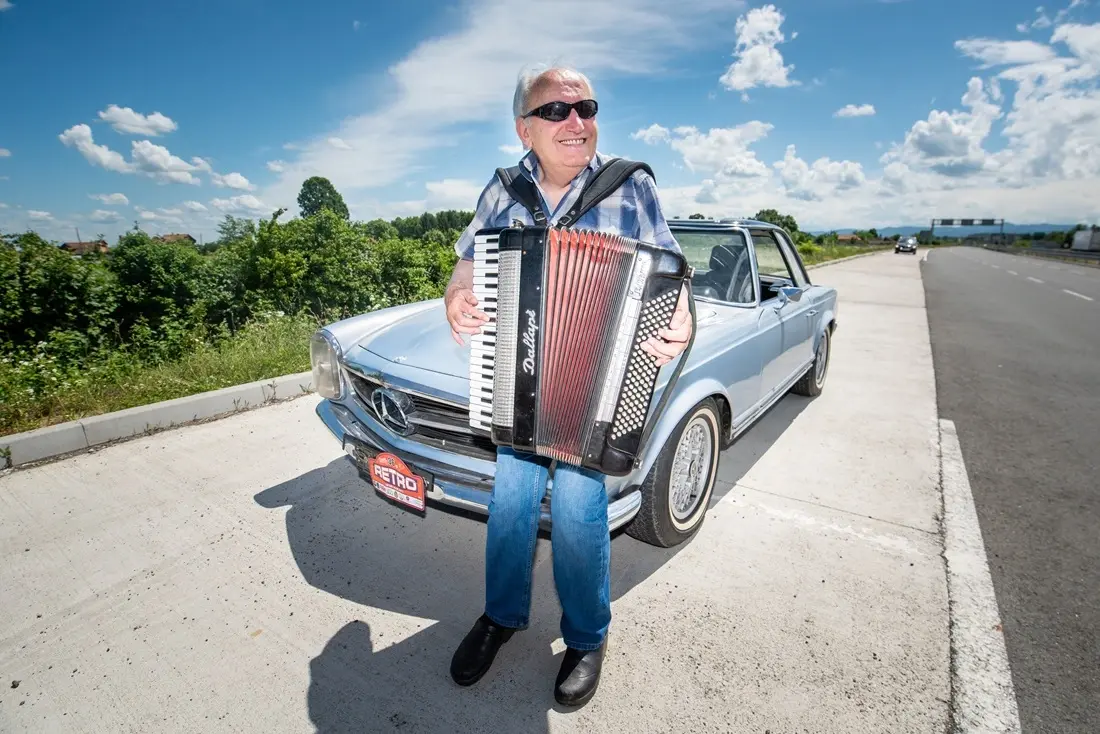
After several kilometers, Rajko pulled over and opened the trunk.
Inside was another of his great loves: his famous accordion.
Standing beside the highway, he began playing the traditional song Svilen Konac (“Silken Thread”), proving that an accordion, no matter how expensive, is worthless without soul.
“Dragan Stojković Bosanac and Branimir Đokić wanted to buy this accordion from me, but I never sold it,” he recalled.
He had performed alongside some of the most famous folk singers in the region and entertained politicians, celebrities, and ordinary people alike.
A Magnet for Attention
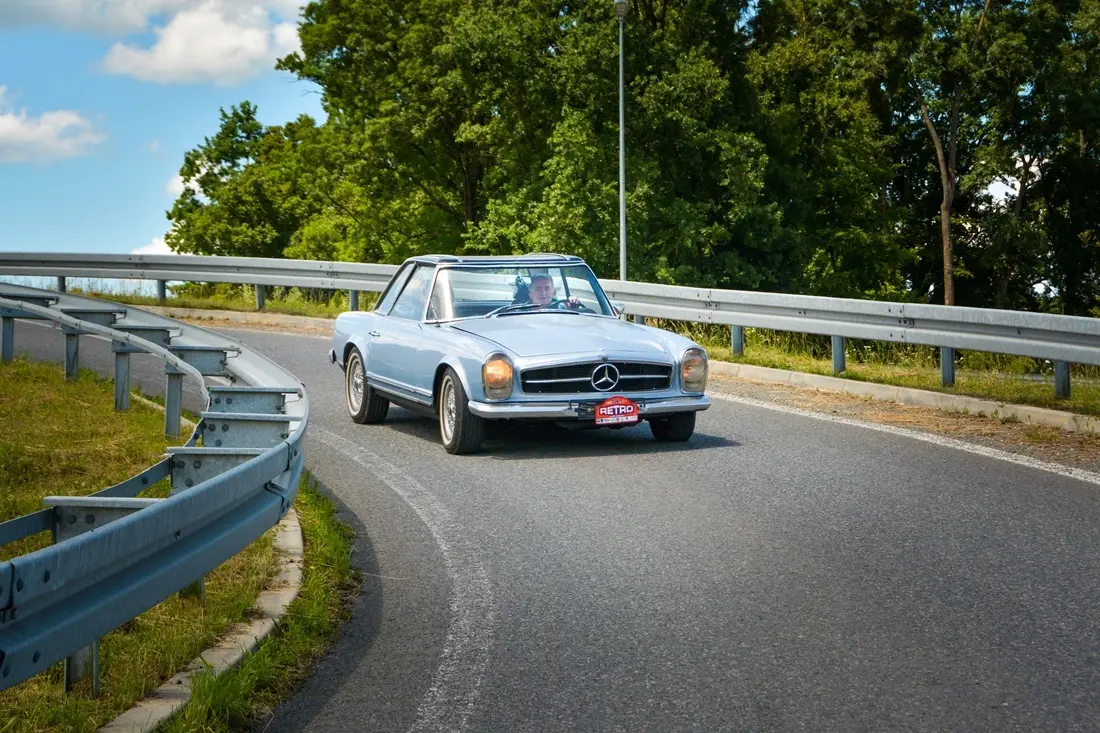
Even if he had wanted to, Rajko could never have gone unnoticed in his bright red Mercedes convertible.
We asked him directly whether women were always attracted to men with expensive cars.
“Of course,” he replied with a grin.
“A bright red convertible was a magnet wherever I went. Sometimes all I had to do was drive behind a bus and flash the headlights. At the next stop, the girls would get off and continue the journey with me.”
The Rarest SL of Them All
Mercedes-Benz introduced the W113 series at the Geneva Motor Show in 1963.
The first version was the 230 SL, followed in late 1966 by the significantly revised 250 SL. However, production of the 250 lasted only until January 1968, when it was replaced by the 280 SL.
As a result, only 5,196 examples of the 250 SL were ever built, making it the rarest model of the entire Pagoda family. More than a third were delivered to the United States.
Today, surviving examples occupy the garages of collectors and celebrities around the world.
Rajko’s, however, remained exactly where it belonged - in a modest garage in Gradiška, carefully protected from moisture and time.
As we prepared to leave, Rajko parked the Mercedes and transferred his accordion into the trunk of an old Opel Corsa.
“The small one earns money so the big one can spend it,” he laughed.
And somehow, after spending a day with Rajko Erceg, it was impossible to tell whether the greater love of his life had been the accordion or the Mercedes.
- Written by: Slobodan Popadić / HEDONIST
- Originally published in HEDONIST Magazine No. 1, 2020
Related articles
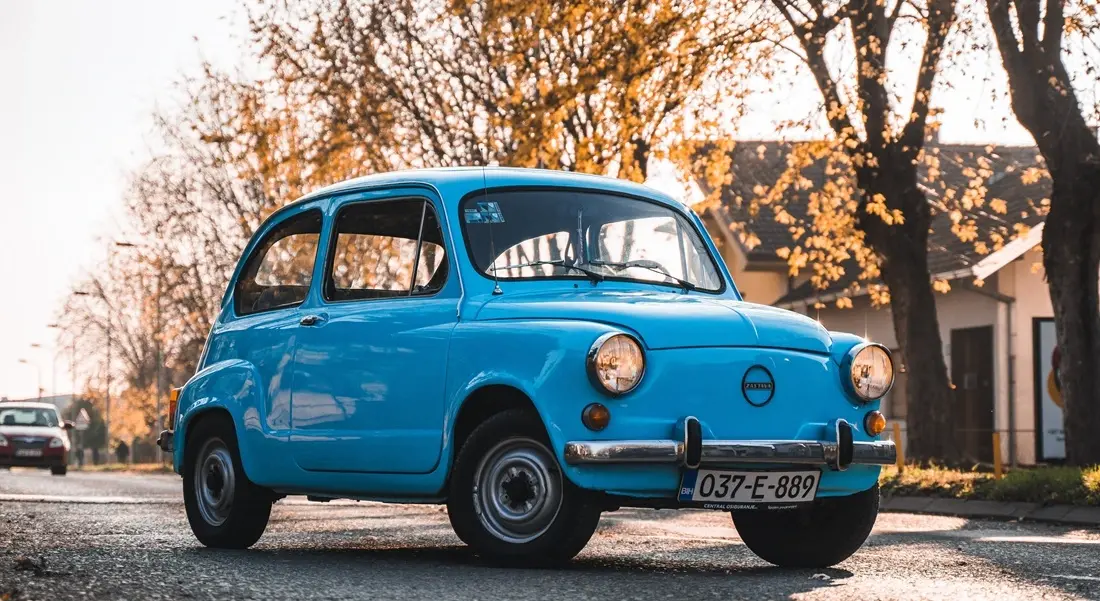
The Little Giant That Refuses to Retire
It has been branded with many slogans: “All cars are driven, only the Fićo is loved,” “Our fathers learned to drive in it,” “The car that motorized Yugoslavia.” It has always remained modest, unique, and unmistakable. Simply put - the Fićo.
Porsche: The Mediterranean Side of German Discipline
On paper, Porsche seems like the perfect definition of German discipline: precision, engineering obsession with detail, and an almost mathematical devotion to driving. Yet the most beautiful Porsche moments rarely have anything to do with discipline.
We Drove the Oldest Car in Bosnia and Herzegovina: The Story of a 1921 Dodge
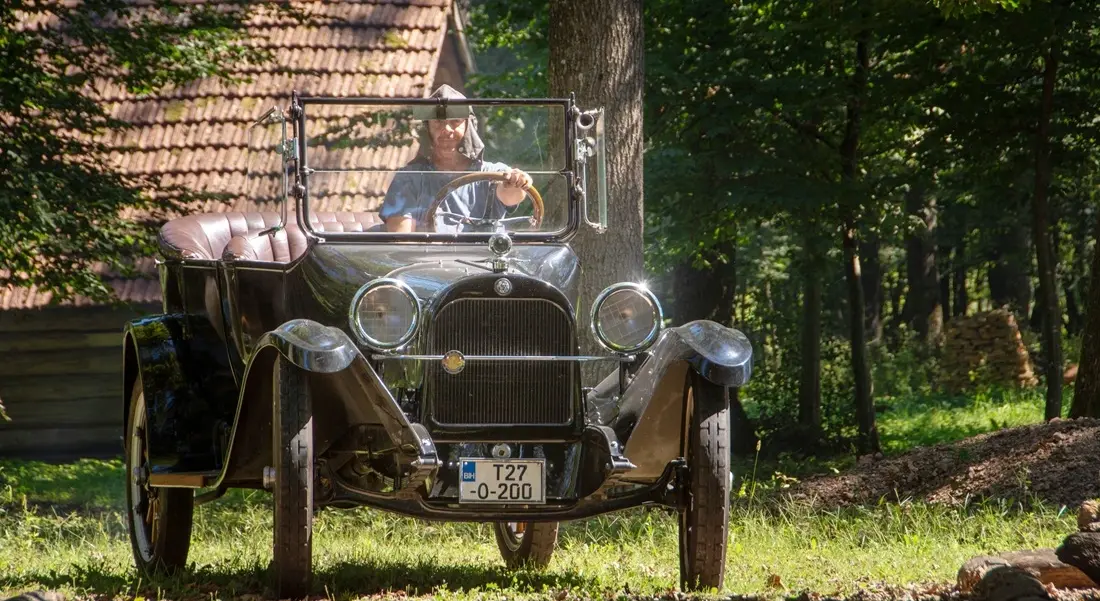
Imagine driving a convertible powered by a 3.5-litre gasoline engine, worth more than 100,000 BAM, yet equipped with no seat belts, no radio, and no turn signals. The HEDONIST Magazine team had exactly that privilege, thanks to the hospitality of Miladin Savičić from Laktaši, owner of the oldest and perhaps most unusual automobile in Bosnia and Herzegovina.
Cars That Became Art
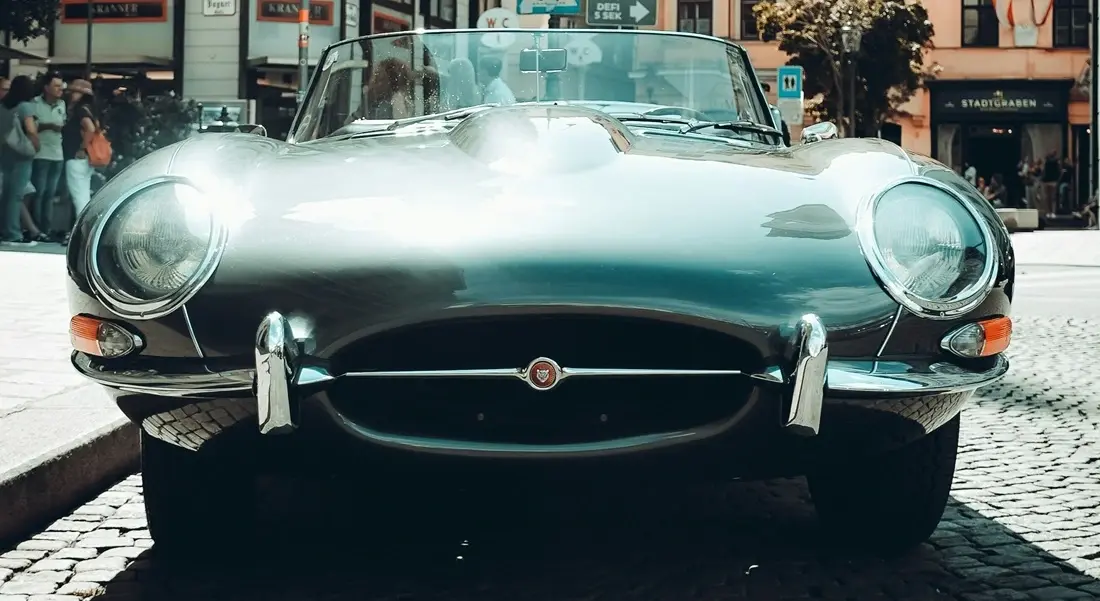
There are cars built to last. And there are those built to be remembered. The classics in this story have long left the garage and entered the history of design. Their lines, proportions, and details are not just technical solutions - they are pure aesthetics. They are not seen merely as transportation, but as sculptures on wheels.