La Marquise: The Car That Won Because No One Else Showed Up

![[object Object]](https://api.hedonistmagazine.net/storage/images/2026/09/c9610483-80b8-422a-b6e1-f503a009b089.webp)
It all began with a toy in the window of a Parisian shop. In 1881, Count Jules-Albert de Dion, a man known in high society as much for the duels he challenged people to as for his fondness for women, was looking for prizes for a ball when his attention was caught by a model steam locomotive. It had been crafted with such precision that he decided to track down the people who had made it.
When he discovered that the toy was the work of two craftsmen, Georges Bouton and his brother-in-law Charles-Armand Trépardoux, he did not simply congratulate them on their workmanship. Instead, he offered them a job: to build the same machine, only on a scale large enough to carry a person.
Their first attempt ended in a catastrophe worthy of a farce. A steam-powered vehicle with its engine and boiler mounted at the front, driven by belts, burned to the ground during a test run. Rather than give up, the three men went back to the drawing board and, in 1884, produced a second version, this time with rear-wheel steering and a drivetrain that finally worked as intended. De Dion named the vehicle La Marquise, after his mother, who, according to family stories, believed her son had completely lost his mind by investing money in such an undertaking.
The irony is that this seemingly ill-fated investment would bring De Dion victory just three years later in a race that, strictly speaking, was barely a race at all. In 1887, the editor of the cycling magazine Le Vélocipède Illustré organised what is now regarded as the first automobile competition in Europe. Only one vehicle appeared at the starting line: La Marquise. It completed the course, reached a speed of almost 60 kilometres per hour, and "won" simply because it was the only entrant who actually turned up. It is difficult to call it a genuine race when there was no one to race against, but a diploma was awarded, and De Dion's name entered history as the winner of the first automobile race on the continent.
The machine itself, although it looks like a cross between a carriage and a locomotive, functions remarkably close to what we would recognise today as an automobile. It has two coupled steam engines, a coal-fired boiler that can be brought up to operating temperature in just 45 minutes, and a water tank holding almost 150 litres, enough for around 20 kilometres of travel. The four seats face back-to-back, hence the French term dos-à-dos. Steering is controlled by a tiller shaped rather like a shovel, and a single driver can operate the entire vehicle without the support crew required to handle the locomotives of the era. It is just under three metres long and weighs nearly a tonne.
The company founded by De Dion, Bouton and Trépardoux that same year, De Dion-Bouton, would eventually become one of the most important names in the early history of motoring. Its engines powered early Renault models and those of other pioneering manufacturers decades later. Trépardoux, meanwhile, remained loyal to steam to the very end and left the company in 1893, as the petrol engine began to take over the industry.
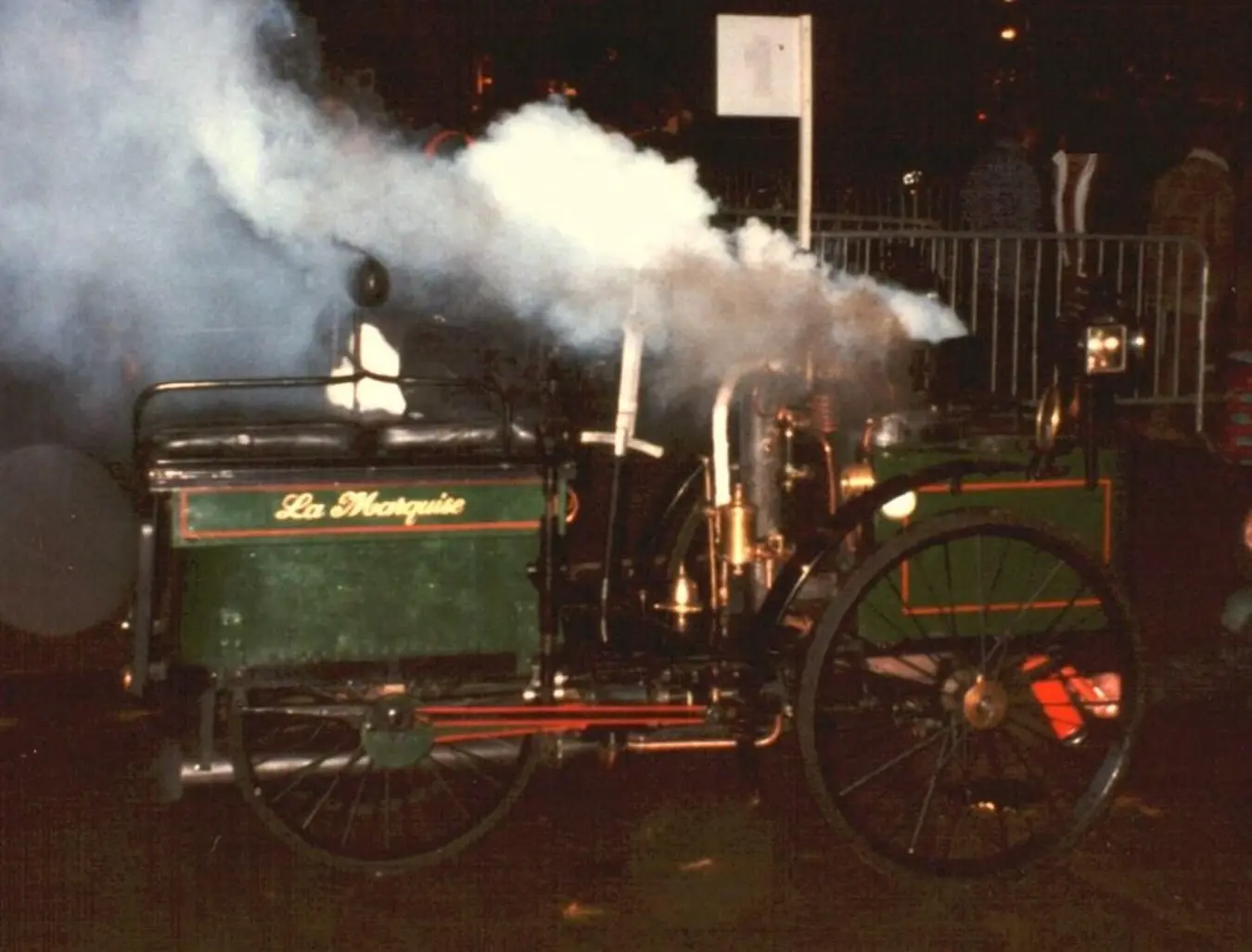
La Marquise, in the meantime, continued to exist as a curiosity rather than as a museum exhibit sealed behind glass. In 2011, the vehicle was sold at an RM Sotheby's auction in Hershey for $4.62 million - still fully operational, still capable of raising steam and driving down the road, 127 years after it was first built.
There is, however, a fair qualification to be made here, because the title of "the world's oldest running automobile" comes with a footnote that is rarely mentioned. There is a vehicle older than La Marquise that is also capable of running: the Grenville steam carriage, built in 1875, essentially a mobile gun carriage converted to carry passengers. For that reason, experts usually describe La Marquise more precisely. It is not absolutely the world's oldest surviving powered vehicle, but it is the oldest functioning automobile in private ownership, and the oldest one that resembles what we would recognise today as a family car - four wheels, room for four passengers, and a single person at the controls rather than an entire locomotive crew.
Perhaps that is the best way to remember the story: a machine born from a toy in a shop window, one that outlived the vehicle that burned down before it, one that "won" a race without an opponent, and one that still moves forward today when a fire is lit beneath its boiler - a reminder that the title of oldest sometimes matters less than the simple fact that something, against all odds, still works.