
Two Suns: When Šavnik Becomes an Open-Air Gallery

![[object Object]](https://api.hedonistmagazine.net/storage/images/2026/08/3c817ef3-1832-4f06-b6c0-aa3125ba6306.webp)
Šavnik isn't a town that receives art the way it might receive a guest who leaves again after a few days. This August, art arrived here differently - on walls, meadows, hills and squares, woven into the river, the morning mist, and the lives of people who know this place's daily rhythm far better than any festival crowd ever could. Four days of the second edition of the Two Suns Art Festival showed what contemporary art looks like when, instead of gallery walls, it's given an entire town.
From August 13 to 16, Šavnik became a meeting point for a wide range of artistic practices - painting, land art, and performance alongside film, music, sound, and workshops. The artists who came here weren't building a festival that could have happened anywhere. Their work grew out of a dialogue with the place itself - its landscape, its architecture, its people, and the stories this corner of Montenegro carries.
That's a natural continuation of a story that began last year. Two Suns grew out of one of Šavnik's stranger local quirks: because of its position between the mountains, the sun appears here twice over the course of a day. That local phenomenon became the starting point for a festival that refuses to separate art from landscape, instead trying to fuse the two into a single experience.
The art that stays behind
The festival's most interesting traces may be exactly the ones that don't disappear along with its final day.
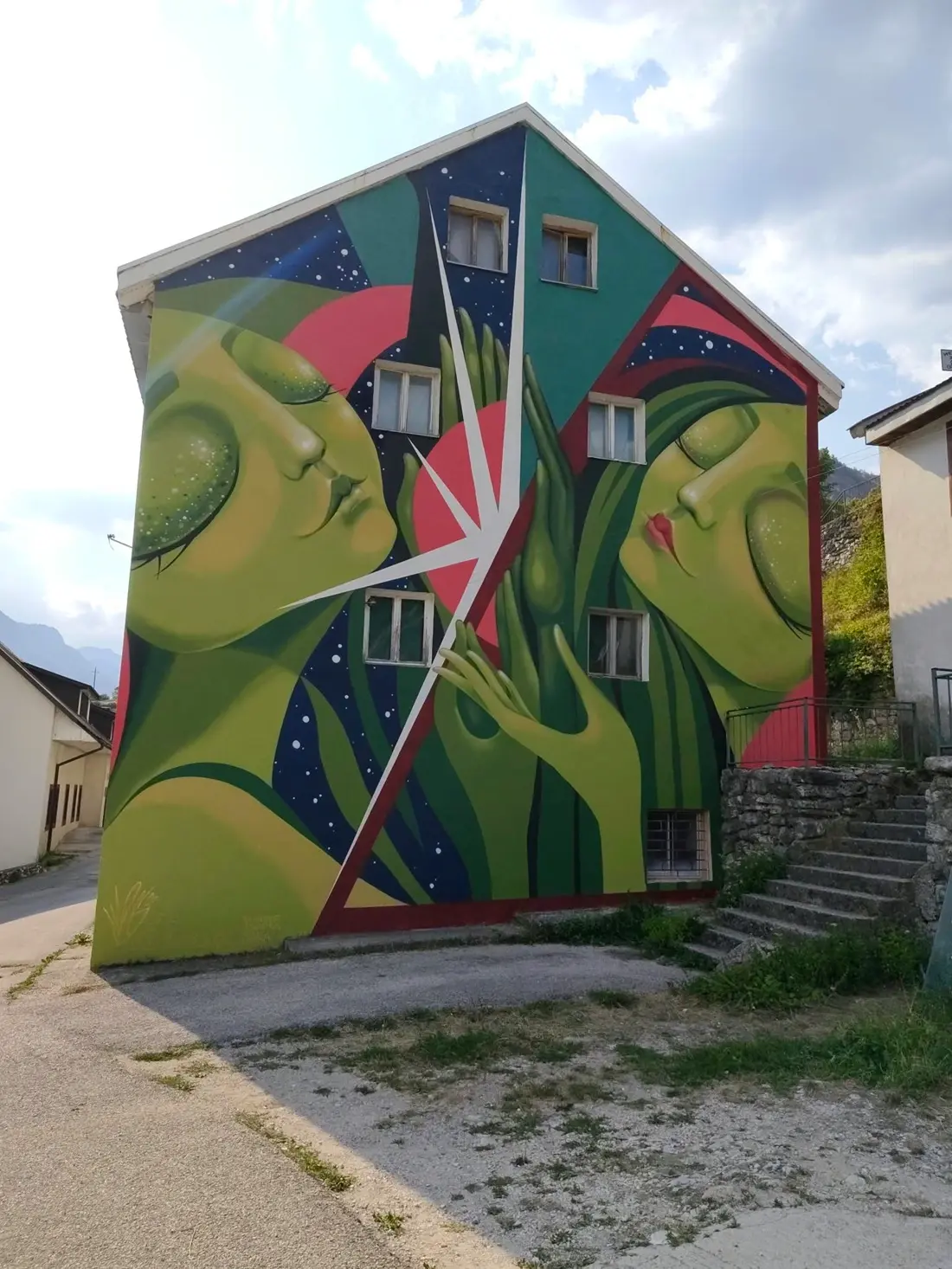
On one of Šavnik's walls, a mural by Marija Šoln, "Origin II - Encounter in the Mirror of Two Suns," now remains as a continuation of an artistic dialogue that began in the festival's first edition. On Gojino Brdo, the hill above town, Konstantin Evdokimov installed a land art piece titled "The Dark Side of the Sun," built from wood and natural materials, letting the landscape itself become part of the work. On the meadow known as Gnijezdo, Sofia Albee left her own mark with a piece called "So Help Me Sun," while Milica Komlenić Vukić expanded Šavnik's artistic map with a work titled "Memories of a Shadow."
All of it was brought together in a closing Art Walk called "Traces of Two Suns," but the real value of these pieces begins only once the crowd disperses. Šavnik now holds points of art that didn't exist before the festival - and that will remain part of its landscape long after August ends.
"We don't want Šavnik to be just a backdrop where the program happens, but a space the work itself grows out of," says the festival's artistic director, Marija Džoganović. "Artists here get to know the place, its landscape, its people and its rhythm, and they respond to all of that through their work. It matters a great deal to us that part of that work stays behind after the festival ends."
The festival has ended. The art hasn't gone anywhere.
That sentence probably holds the real difference between a festival that simply visits a town for a few days and one that builds something more lasting with it.
Music between the mountains
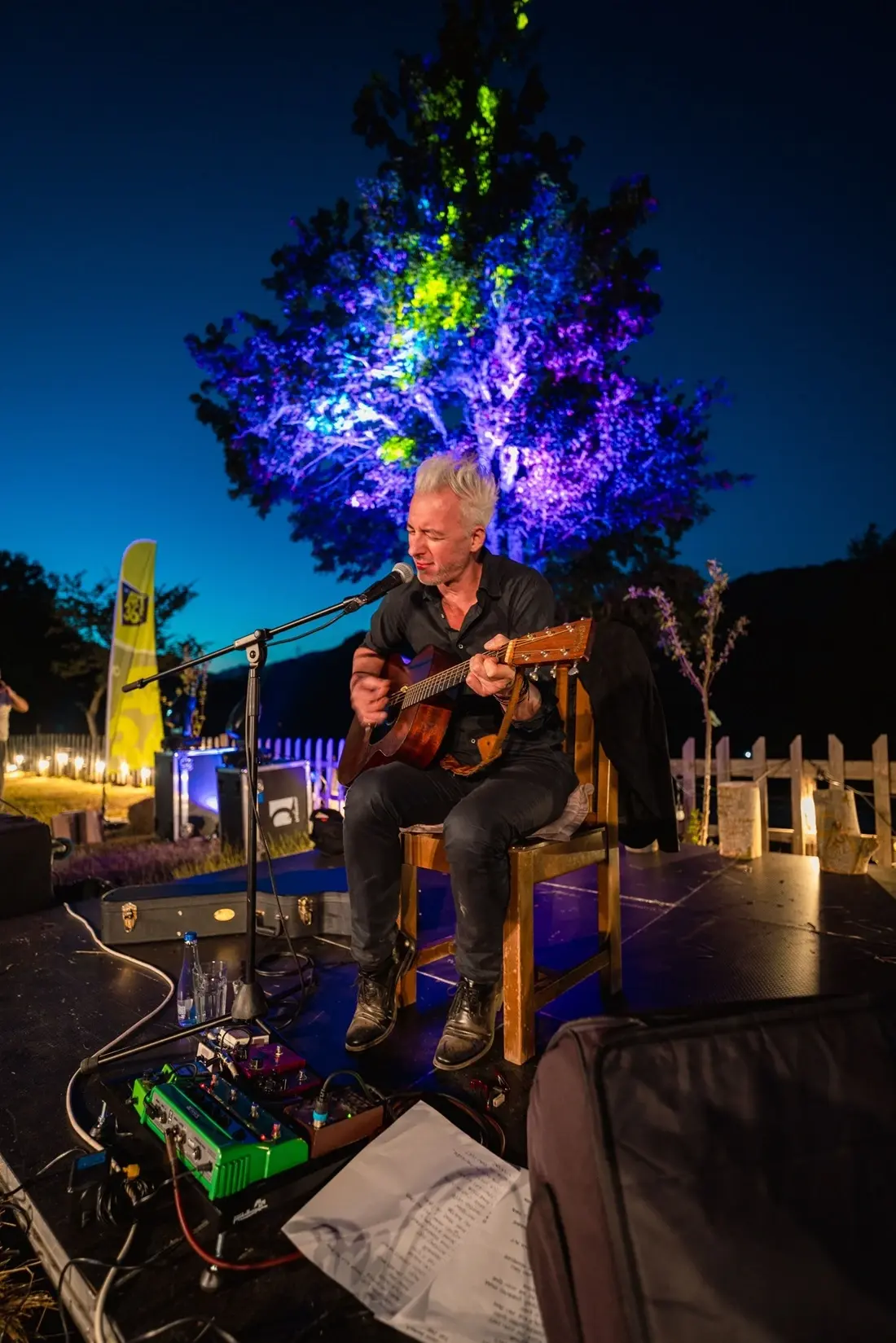
When music moves from a concert hall to a meadow, the way we listen to it changes too. This year, that space in Šavnik was Gnijezdo, where Kralj Čačka and Stray Dogg performed. There was no stage cutting the performers off from the crowd - just a landscape that became part of the concert itself.
A similar principle ran through the rest of the program. Mornings began with movement, breath, and sound, through sessions led by Sanja Čolić and Ina Bulgakova, while Ivana Martinović opened up a space for personal, spontaneous creation through her workshop "Source - Expressive Artistic Practice."
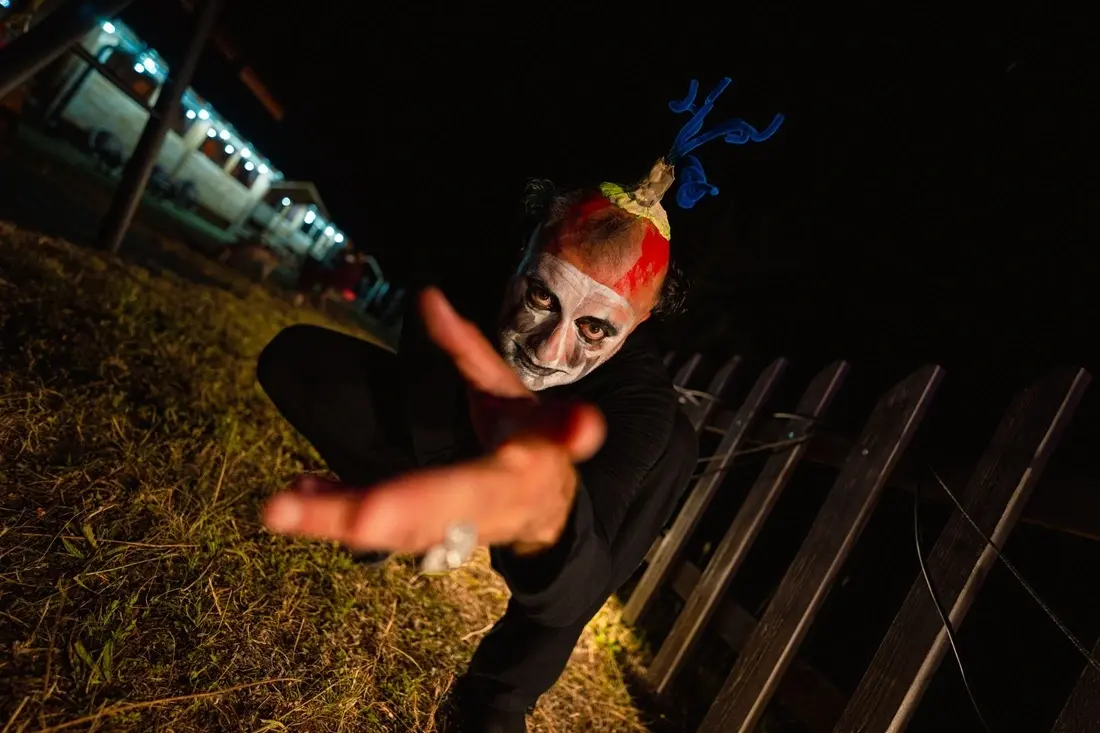
At other moments, Šavnik turned into a screening room, a space for video art, a performance stage, or an improvised studio. Luigi Grey Benassai presented a performance and film titled Mimo, Portrait of a Modern Mime, Zvjezdana Dervić performed Omnia Mea Mecum Porto, and the film and video program brought together work by Hana Rastoder, Galina Bakinova, Ivana Šarović, and Aleksandar Lazar.
The animated short Pod i Gorica, by Jovana Jovanović and Petar Đurišić, used what looks like a simple form to raise questions about identity, changing space, urbanization, and a city's relationship to nature - themes that carried extra weight precisely because they were being discussed from Šavnik.
When the day begins with art
One of the festival's standout moments happened in a place few would expect - right at the start of the day.
The final festival morning was marked by Sunrise Art Jam on Trg Matije Jakića. Zvjezdana Dervić's aerial dance performance met Goran Lončarević's ambient live sound right as dawn broke, at the exact moment the town was waking up.
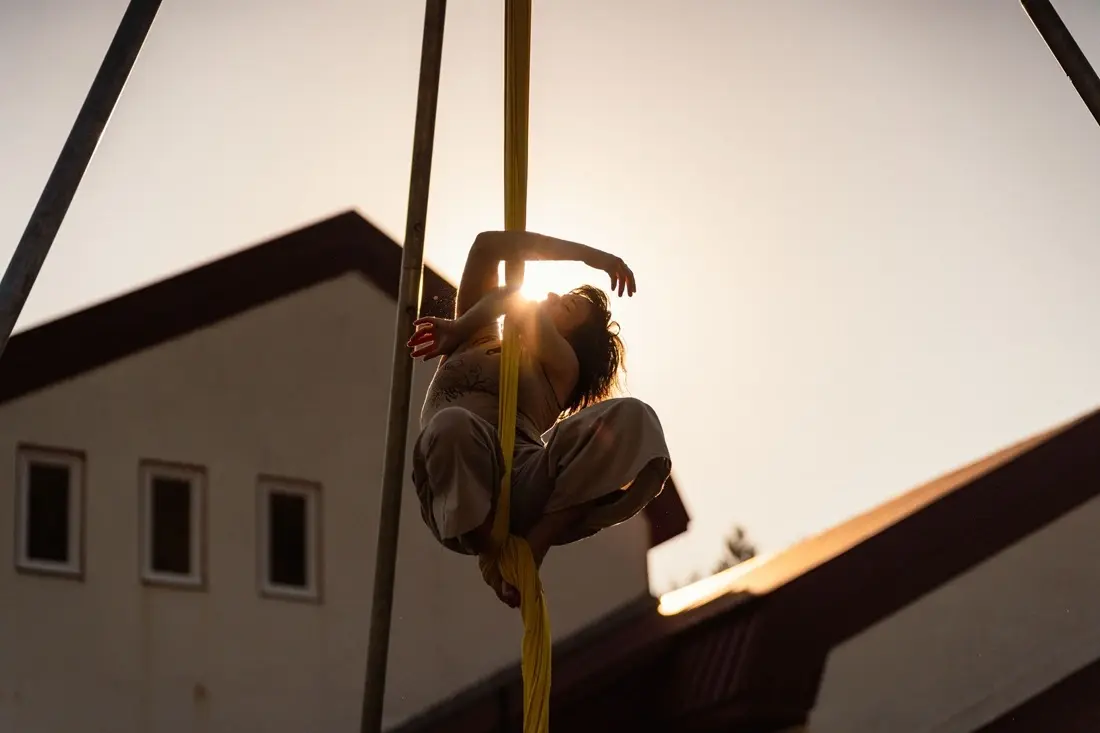
It may be the clearest example of what Two Suns is trying to do: here, time, landscape, sound, and movement become equal parts of the experience, not simply a backdrop to the program.
The same held for the workshops - from Balša Gobović's cyanotype session to Marko Gošović's "Organic Synthesizer," which turned the sounds of nature into the raw material for a MIDI instrument. The audience here wasn't just there to view finished work; they were invited into the process of making it.
A festival that doesn't want to just be a festival
What's most interesting about Two Suns, then, isn't the number of programs, performers, or artists involved. It's the ambition for the festival to become something more lasting than four days in August.
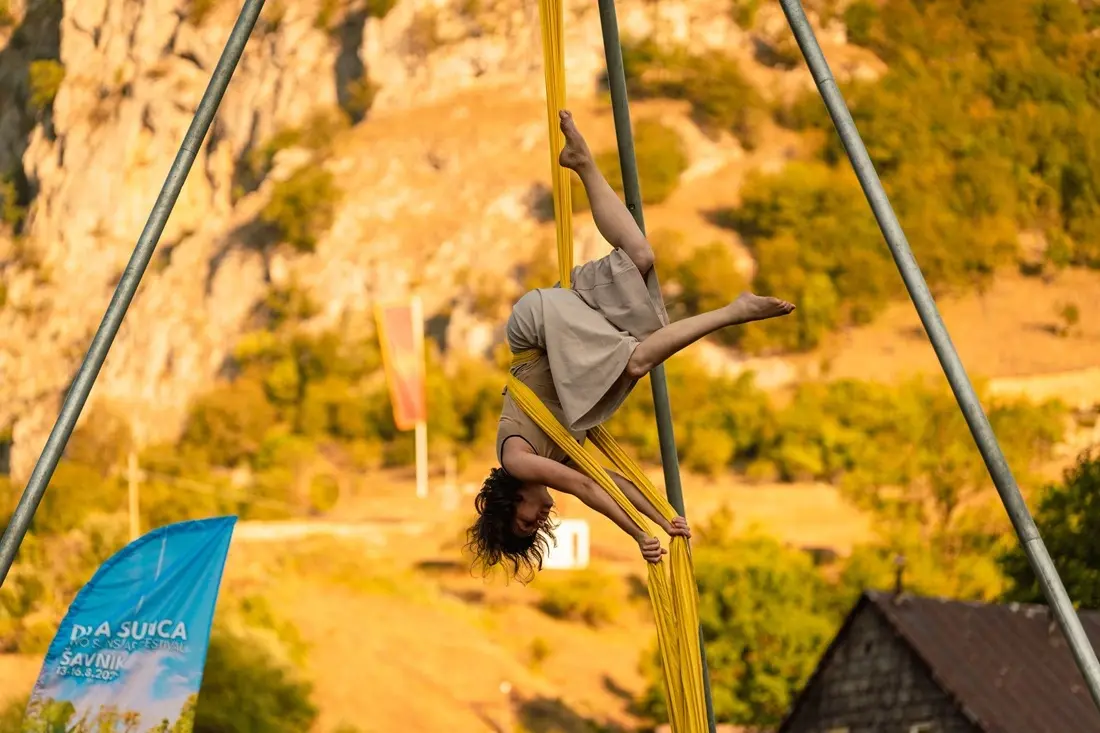
"When we started last year, we wanted to build a festival that wouldn't just pass through Šavnik for a few days. We wanted a process that would grow alongside the place," says festival director Branimir Žugić. "Today we're already seeing the first results - artists who come back, new ones who show up for the first time, audiences discovering Šavnik because of the festival, and, something that matters enormously to us, work that stays here."
That might be the most interesting cultural potential of an event like this. Once the festival is over, the last concert has ended, the last visitor has gone home, and the festival lighting is switched off, one question remains: what has actually been left behind for the town?
In Šavnik's case, the answer is visible on its walls, its hills, its meadows. But it doesn't end there. What also remains are the people who came to this place for the first time because of the festival, the artists who got to know it from an entirely different angle, and a local community that got the rare chance to see its own surroundings through the eyes of someone who doesn't live there.
That process probably carries more weight than the festival itself. A small town becomes a cultural destination precisely when it stops trying to hide what makes it different - and instead turns that difference into an advantage.
Which is why the second edition of this festival will likely be remembered less for its dates, August 13 to 16, and more for what it left behind: a mural on a wall, an installation on a hill, a piece in a meadow, and new stories now woven into the story Šavnik was already telling.
The festival has ended. The art hasn't gone anywhere.