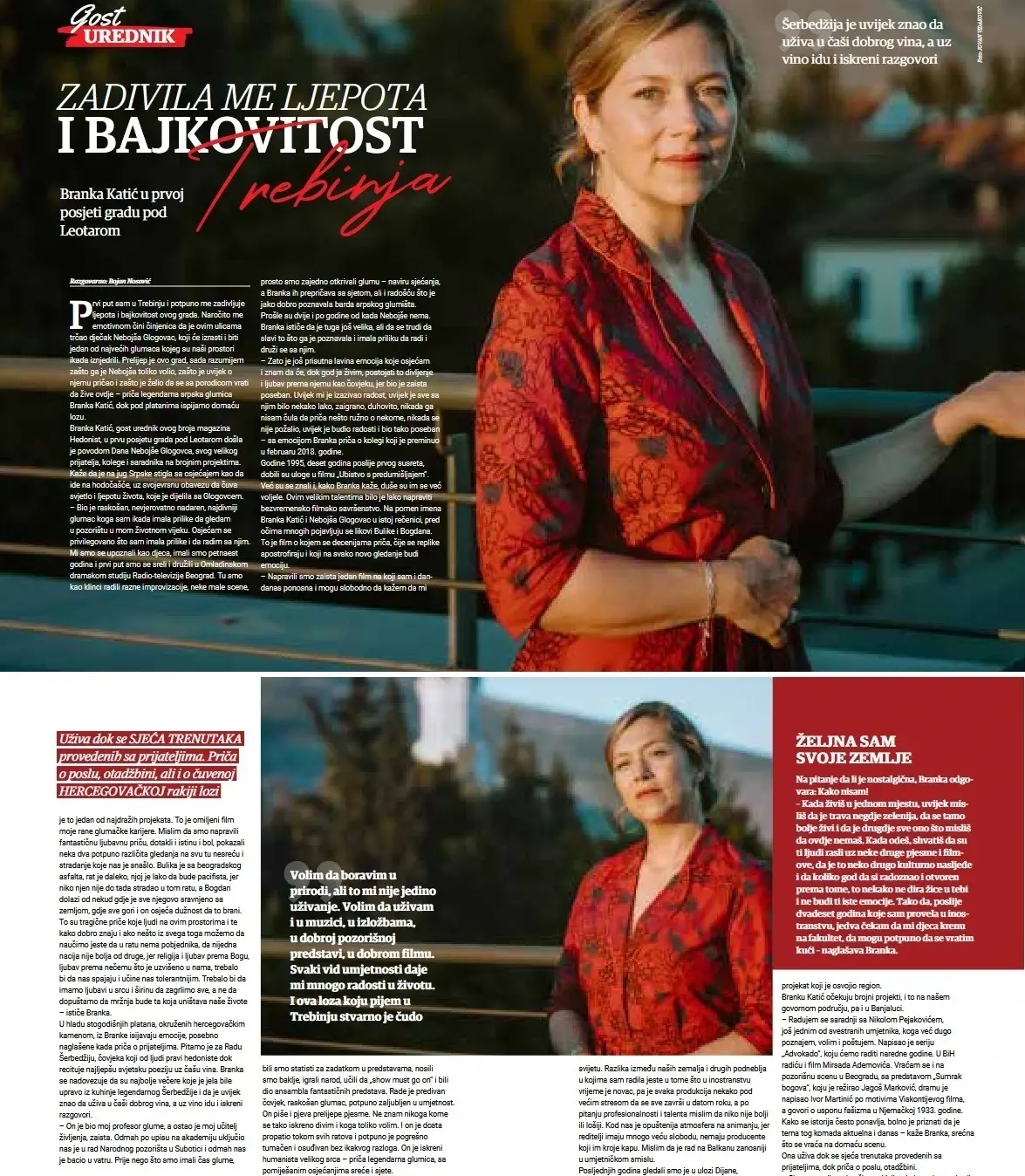
Branka Katić for HEDONIST: I Was Captivated by the Beauty and Fairytale Charm of Trebinje

![[object Object]](https://api.hedonistmagazine.net/storage/images/2026/04/f1522c29-4f6d-4379-a32a-931584dc09ab.webp)
“This is my first time in Trebinje, and I am completely captivated by the beauty and fairytale charm of this city. What makes it especially emotional for me is the fact that a young Nebojša Glogovac once ran through these very streets, growing up to become one of the greatest actors our region has ever known. It is a beautiful city - now I understand why Nebojša loved it so much, why he always spoke about it, and why he wanted to return here with his family”.
This is what the legendary Serbian actress Branka Katić tells HEDONIST magazine, as we sip homemade loza brandy under the plane trees. Our interlocutor came to the city beneath Mount Leotar for the first time on the occasion of the Days of Nebojša Glogovac, her close friend, colleague, and collaborator on numerous projects. She says she arrived in the south of Republika Srpska with a feeling akin to a pilgrimage, carrying a sense of responsibility to preserve the light and beauty of life she shared with Glogovac.
“He was magnificent, incredibly gifted - the most wonderful actor I have ever had the chance to watch on stage in my lifetime. I feel privileged to have had the opportunity to work with him. We met as children, we were fifteen, and we first encountered each other at the Youth Drama Studio of Radio Television Belgrade. As kids, we worked on improvisations, small scenes - we were discovering acting together,” Branka recalls with both nostalgia and joy, grateful for having truly known one of the greats of Serbian theatre.
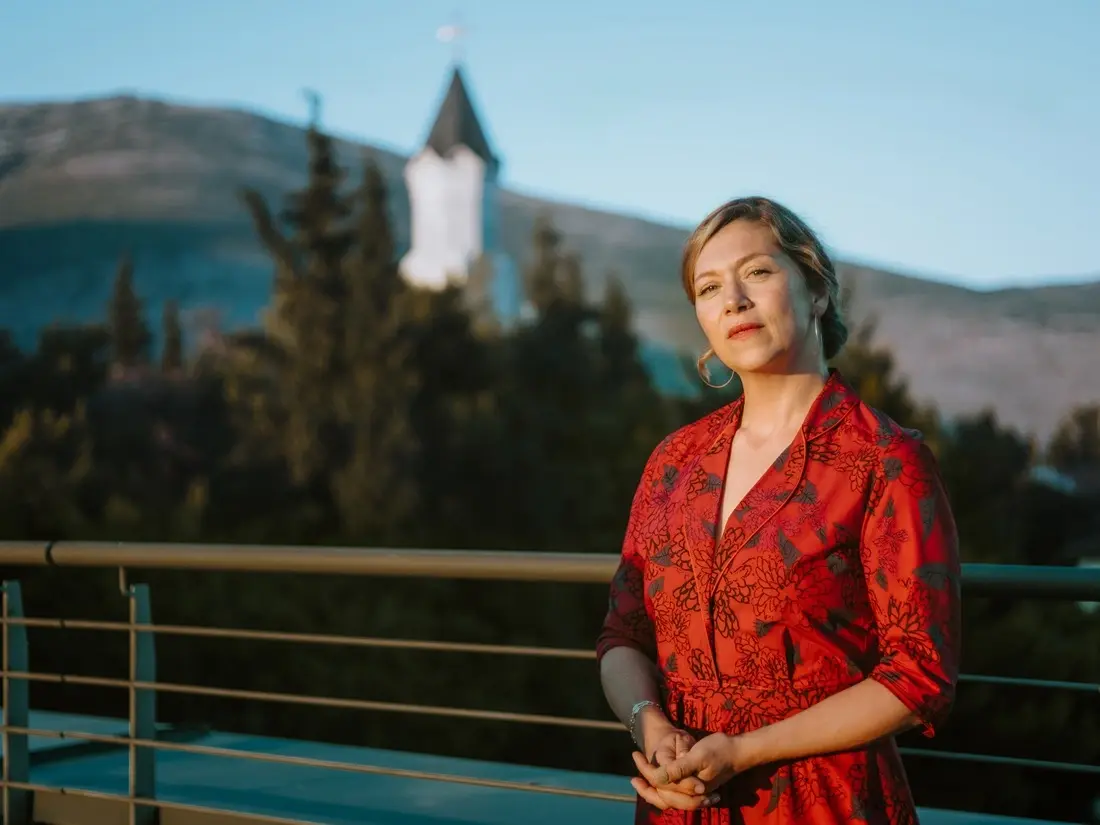
Editor’s note: This text is part of the HEDONIST archive and was originally published in 2020 in the second issue of the print edition.
Two and a half years have passed since Nebojša’s death. Branka says the grief is still strong, but she tries to celebrate the fact that she knew him and had the opportunity to work and spend time with him.
“That’s why this wave of emotions is still present, and I know that as long as I live, that admiration and love for him as a person will remain, because he was truly special. He always brought joy; everything he did was somehow easy, playful, and witty. I never heard him speak ill of anyone; he never complained - he always brought happiness and was so unique,” she says emotionally about her colleague who passed away in February 2018.
She enjoys recalling moments with friends, speaking about work, homeland, and the famous Herzegovinian loza brandy.
In 1995, ten years after their first meeting, they were cast in the film Premeditated Murder. They already knew each other well and, as Branka says, their souls had already connected. For such great talents, creating timeless cinematic art came naturally. At the mention of Branka Katić and Nebojša Glogovac in the same sentence, many immediately recall the characters Bulika and Bogdan - a film that has been talked about for decades, quoted, and rediscovered with emotion every time it is watched again.
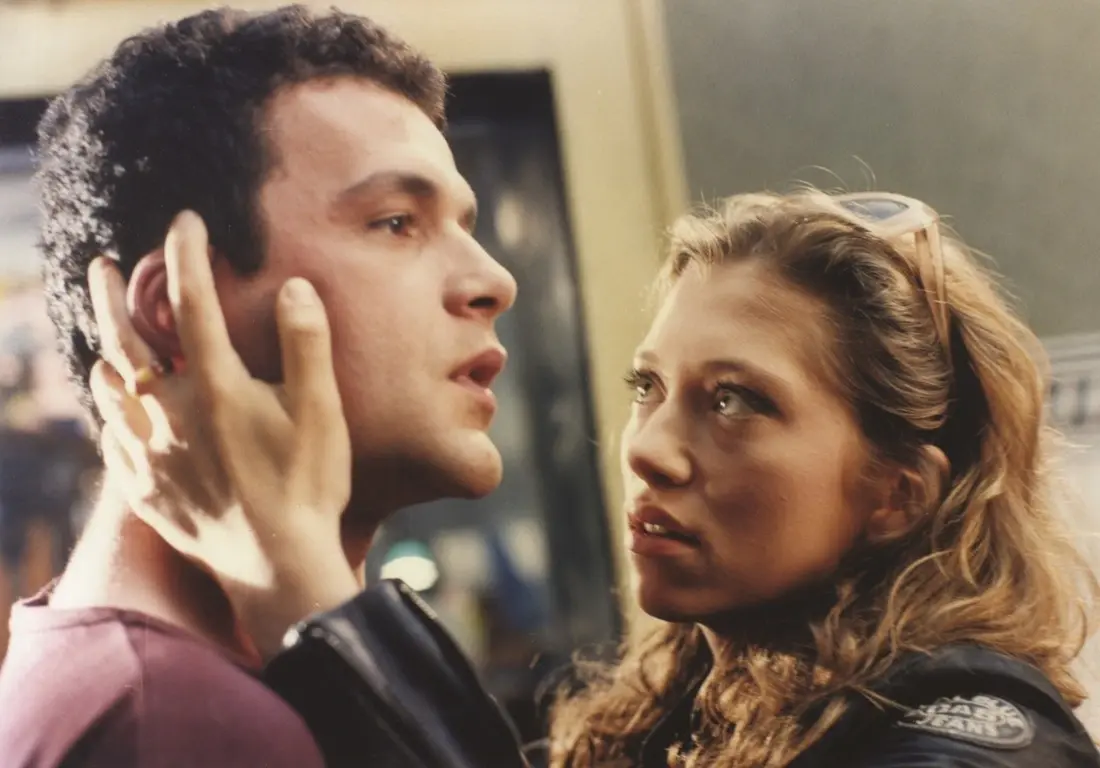
“We truly made a film I am still proud of today. I can freely say it is one of my favorite projects - my favorite from my early acting career. I believe we created a fantastic love story, touching both truth and pain, showing two completely different perspectives on the tragedy and suffering that befell us. Bulika comes from Belgrade, far from the war, so it’s easy for her to be a pacifist, while Bogdan comes from a place where everything he had was destroyed, where everything is burning, and he feels a duty to defend it. These are tragic stories that people in this region know all too well. If there is something to learn from it, it is that there are no winners in war, that no nation is better than another. Religion and love for something greater should unite us and make us more tolerant,” Branka emphasizes.
In the shade of century-old plane trees, surrounded by Herzegovinian stone, emotions radiate from Branka - especially when she speaks about friends. When asked about Rade Šerbedžija, a man who turns people into hedonists while reciting the world’s most beautiful poetry over a glass of wine, she adds that some of the best meals she has ever had came from his kitchen.
“He was my acting professor, but he remained my teacher in life. From the very beginning, he involved us in the work of the National Theatre in Subotica and threw us straight into the fire. Before we even had acting classes, we were extras in plays, carrying torches, playing crowds, learning that ‘the show must go on.’ Rade is a wonderful man, a magnificent actor, deeply in love with art. He writes and sings beautiful songs. I don’t know anyone I admire and love more. He suffered a lot during the wars and was often misunderstood and unjustly judged. He is a true humanist with a big heart,” says the actress, with a mix of happiness and nostalgia.
Branka lived in the United States for eight years, and in 2013, moved to London to be closer to Belgrade and her family.
“Career-wise as well, London keeps me closer to this region, where I truly believe I can get better and more meaningful roles. I’ve worked all over the world. The difference between our region and abroad is that time is money there, so productions are under more pressure to meet deadlines. But in terms of talent and professionalism, no one is better or worse. Here, the atmosphere on set is more relaxed, and directors have more freedom. I believe working in the Balkans is more inspiring in an artistic sense,” she says.
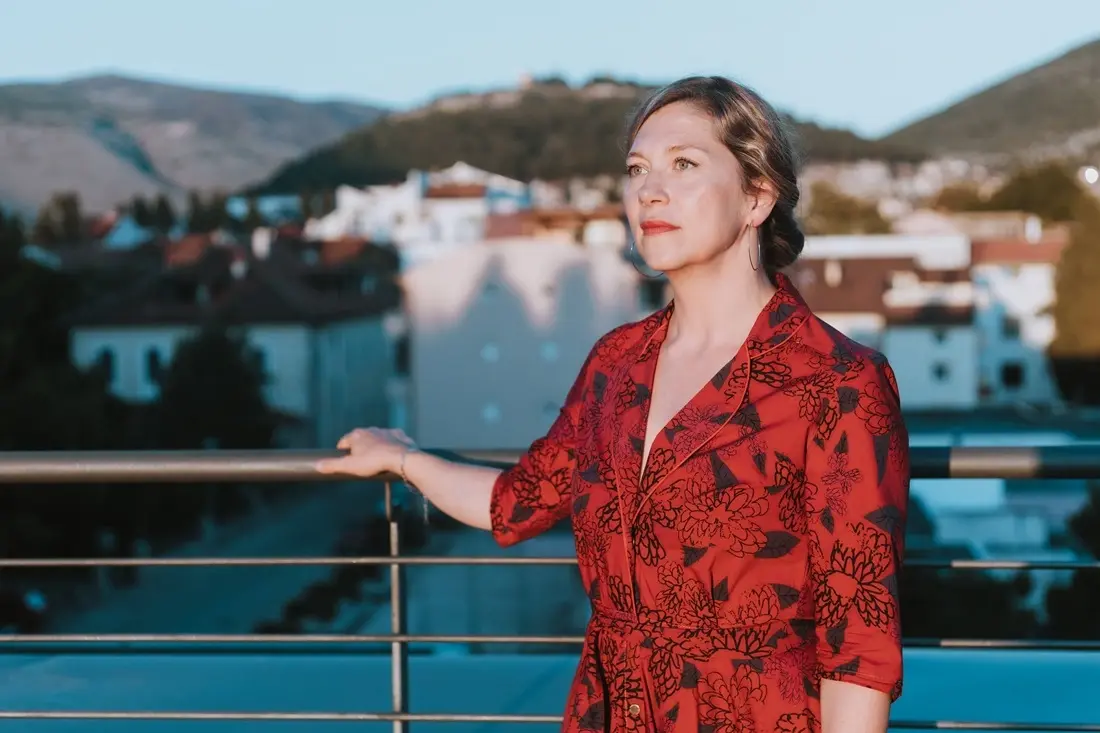
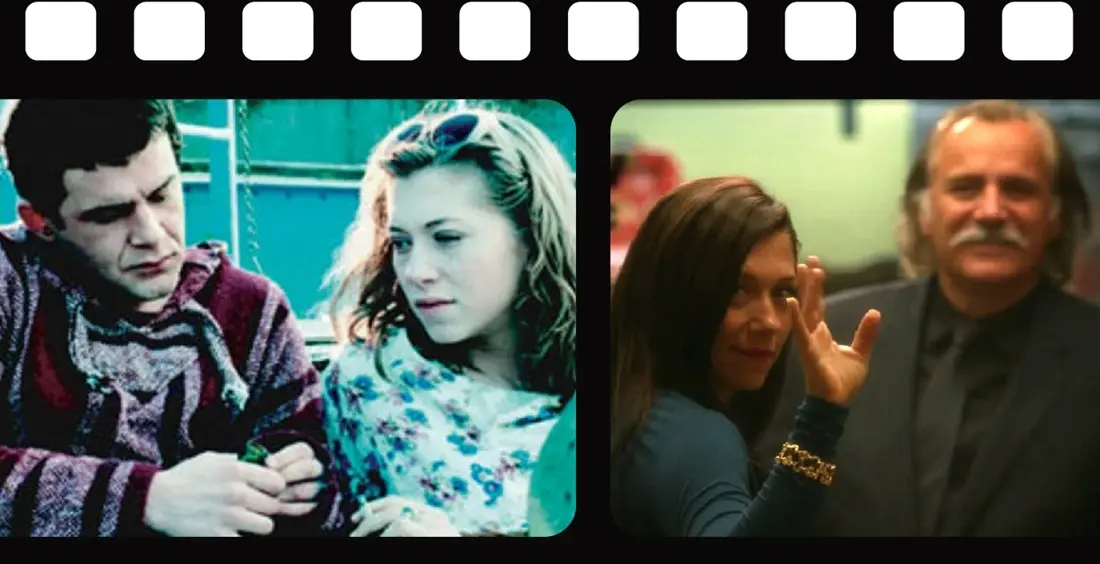
In recent years, audiences have watched her as Dijana, a fearless and incorruptible journalist in the series The Paper. While many hoped for a continuation, Branka explains that the story has concluded.
“With the third season, that trilogy was completed. It was never intended to go beyond that. It’s one of the projects I’m proud of - it restored my faith and love for acting because I got a complex, well-written role and worked with an outstanding director, Dalibor Matanić, who created a powerful and original story about today’s world, the degradation of journalism, and the relationship between politics, corruption, and media,” she says.
Branka has numerous upcoming projects in the region, including in Banja Luka.
“I’m looking forward to working with Nikola Pejaković, another versatile artist I’ve known, loved, and respected for a long time. He wrote the series Advokado, which we’ll be filming next year. In Bosnia and Herzegovina, I will also work on a film by Mirsad Ademović. I’m returning to the theatre stage in Belgrade with the play Twilight of the Gods, directed by Jagoš Marković. The drama, written by Ivor Martinić, is inspired by Visconti’s film and deals with the rise of fascism in Germany in 1933. As history often repeats itself, it is painful to admit how relevant this theme still is today,” Branka says.
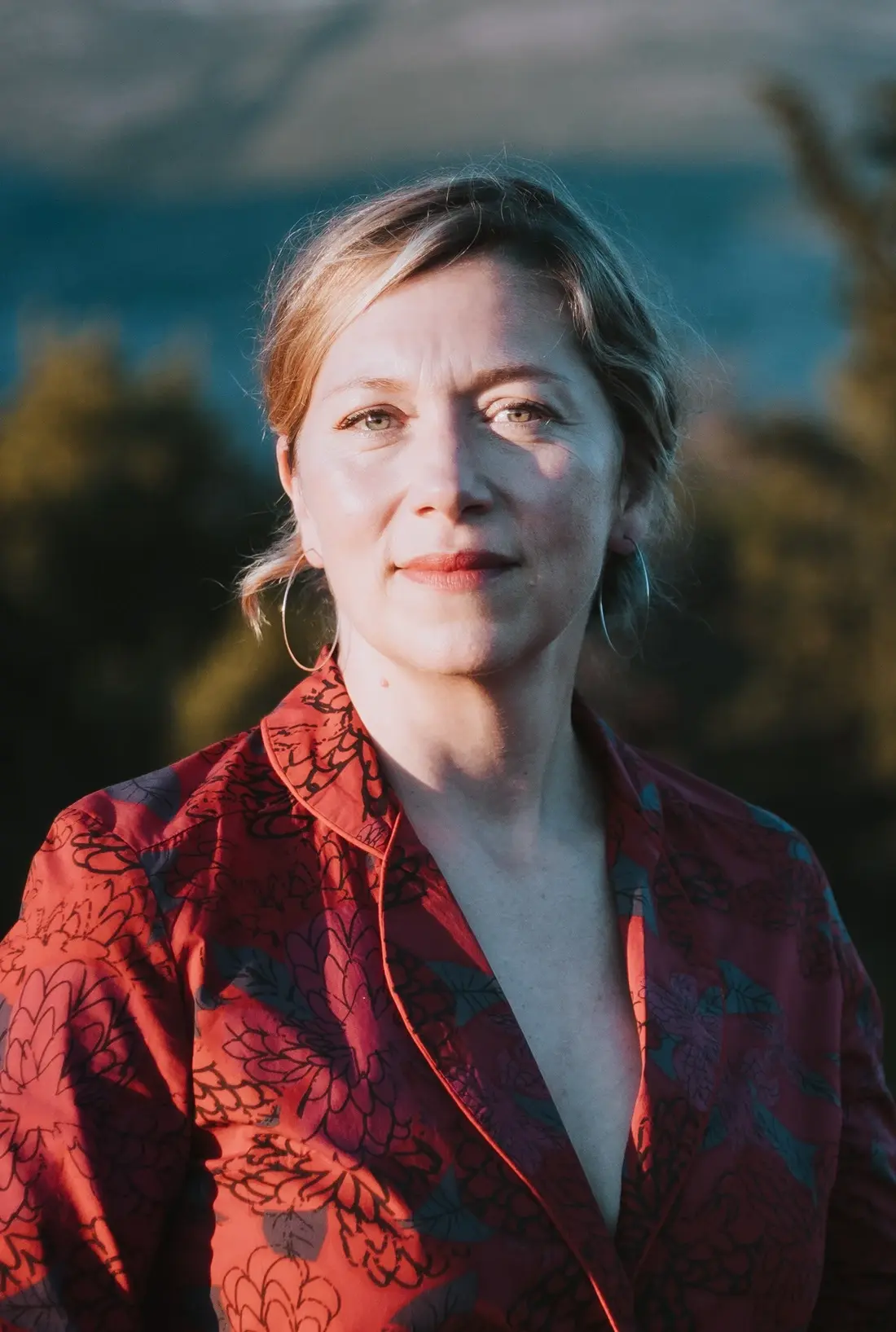
She enjoys recalling moments spent with friends, speaking about work, and her homeland.
“I definitely know how to enjoy life. I love spending time in nature, but that’s not my only pleasure. I enjoy music, exhibitions, theatre, and good films. Every form of art brings me joy. And this loza I’m drinking in Trebinje - it’s truly something special, as are these mountains around us,” she says with a smile.
We spoke with Branka in a fairytale setting, beneath the famous plane trees of Trebinje. She described the southernmost city of Republika Srpska as a place of pure enjoyment - something the whole world should see.
Longing for Home
When asked if she feels nostalgic, Branka answers without hesitation: “Of course I do!”
“When you live in one place, you always think the grass is greener somewhere else. But when you leave, you realize people there grew up with different songs, films, and cultural heritage. No matter how open you are, it doesn’t touch you in the same way. After twenty years abroad, I can’t wait for my children to go to university so I can fully return home,” she says.
- Interview: Bojan Nosović / HEDONIST
- Photos: Jovan Vidaković / HEDONIST
- Published in HEDONIST Magazine, Issue 02, 2020