
What the West Pays Expensively for Today, the Balkans Still Have Right Outside Their Homes

![[object Object]](https://api.hedonistmagazine.net/storage/images/2026/05/7815b62b-33f9-4ccd-af63-3a65771ebd81.webp)
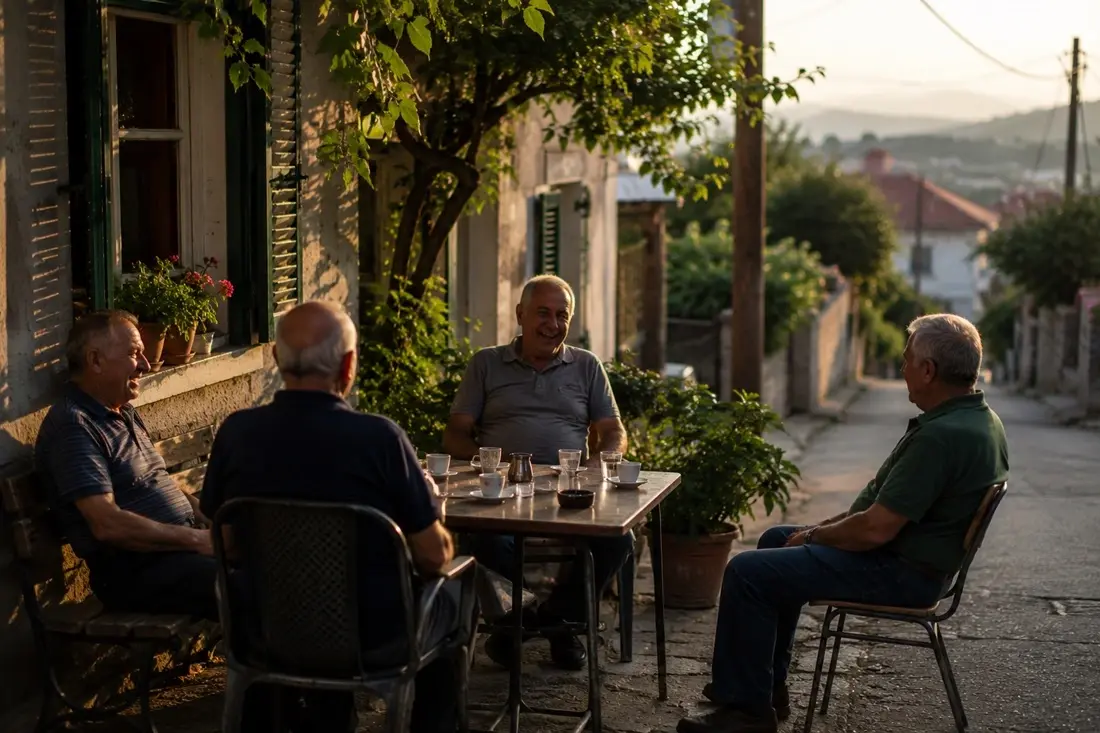
There are places in the Balkans where the day still does not end with the glow of a screen turning off. In the evening, when the sun softens the facades and the asphalt finally stops radiating the day’s heat, chairs begin appearing in front of houses. First one. Then another. Someone brings out a small wooden stool. Someone else carries a beer. Someone slices a watermelon. Someone simply brings silence.
And almost always, the same scene unfolds: people sitting outside their homes, watching life pass by. Without any particular reason. Without a plan. Without the need to turn the moment into content.
While the West today organizes slow-living workshops, digital detox programs, and mindful retreats priced like luxury holidays, the Balkans still have people who bring a chair outside in the evening and talk for hours with no real purpose at all.
And perhaps that is exactly why this part of the world still preserves something the rest of the planet has almost completely lost.
The Last Luxury That Isn’t for Sale
In many Balkan towns and villages, that old evening ritual still exists. The street becomes a living room. Neighbors step outside as soon as the sun begins to set. Someone brings coffee in a small fildžan cup, someone pours rakija, someone arrives carrying cherries or sunflower seeds wrapped in newspaper.
Children ride bicycles between parked cars. Dogs sleep in the middle of the road. Somewhere inside a house, the television is playing, though nobody is truly listening.
Time slows down. At first glance, nothing seems to be happening. But that is precisely the point.
Because perhaps the greatest luxury today is no longer a private jet or a five-star hotel. Perhaps the greatest luxury is having enough peace to sit outside your house in the evening without feeling like you are wasting time. Perhaps the greatest luxury is having a neighbor you can say to: “Come, sit for a while.”
The Balkans and the Art of Meaningless Conversation
The Balkans have never been particularly efficient. Trains run late. Coffee lasts too long. People often stop in the middle of the street just to talk.
And that is exactly why the region remained immune for so long to the obsession with productivity that swallowed the rest of the planet.
Here, conversations are still held without a clear reason or predefined purpose. People sit for hours discussing the weather, sports, neighbors, politics, children, old times, or something entirely unimportant. And nobody asks: “But what’s the point?”
In the Balkans, the point is often that there is no point at all.
In a world constantly demanding results, goals, and optimized schedules, this kind of purposeless conversation has become almost revolutionary.
The Slowness the World Is Trying to Relearn
Today, cities like London, Copenhagen, and Los Angeles offer breathing workshops, silence retreats, and wellness centers where people learn how to spend a few hours without their phones.
Meanwhile, in the Balkans, there are still people who have spent thirty or forty years sitting outside their homes every evening without ever imagining it should become a wellness concept.
It is not a trend. It is not therapy. It is not a lifestyle strategy. It is simply life.
Of course, the Balkans are changing too. There are fewer chairs outside homes than before. Fewer spontaneous conversations. Younger generations look at phones more often than at their neighbors. Streets are quieter now.
But the ritual has not disappeared. There are still summer evenings when someone calls out from across the street: “Come over for coffee.” And that “coffee” often lasts three hours.
People Who Still Know How to Be Present
Perhaps that is what makes these small Balkan scenes so moving. The people sitting outside their homes are not trying to escape life. They are completely inside it.
They are not chasing experiences. They are not documenting happiness. They are not turning everyday life into a performance.
They sit. Watch the street. Greet passersby. And share silence long enough for it to stop feeling uncomfortable.
At a time when loneliness has become a global epidemic and social media a substitute for real human relationships, those plastic chairs outside Balkan homes may represent the final remnants of a slower and more humane world. A world in which people did not need to go on a retreat to find peace.
It was enough to bring a chair outside the house.