

Brain Rot: Thoreau’s Reproach, Turned Into a Joke

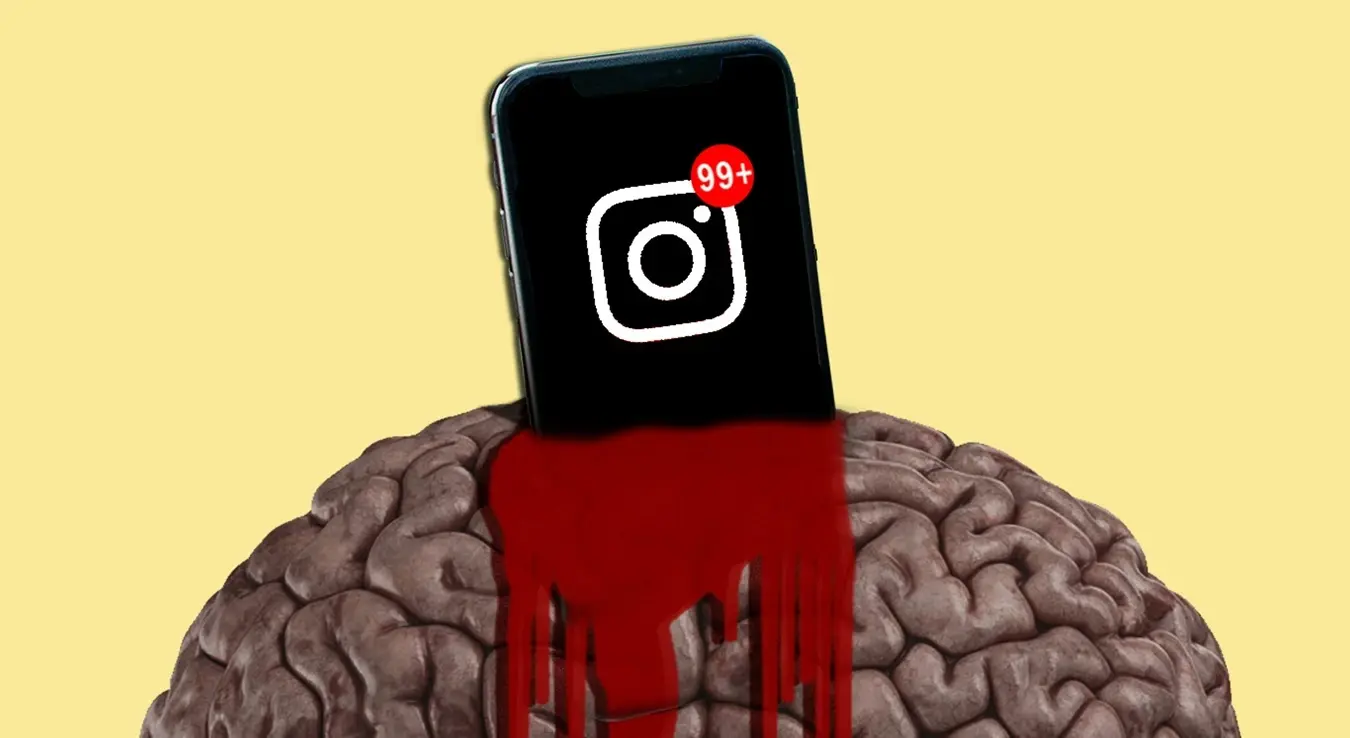
In 2024, Oxford named a 170-year-old phrase its Word of the Year. What endless scrolling actually does to attention, and what science has yet to prove.
In 1854, in Walden, Henry David Thoreau wrote a sentence that reads like a social media post today: “While England endeavors to cure the potato-rot, will not any endeavor to cure the brain-rot, which prevails so much more widely and fatally?” He was asking why we always level downward, to our dullest perception, and call it common sense.
A hundred and seventy years later, the phrase became the Word of the Year. On December 2, 2024, following a public vote of more than 37,000 people, Oxford University Press chose it from a shortlist of six; demure, dynamic pricing, lore, romantasy and slop were left behind. Its frequency of use rose 230 percent between 2023 and 2024, and it first gained momentum on TikTok. Oxford defines it as the supposed deterioration of a person’s mental or intellectual state, especially from overconsuming content, now mostly online, that is considered trivial or undemanding.
The key word is “supposed.” Most people who use it today do so as a joke: Oxford notes that communities of Gen Z and Gen Alpha use it humorously and self-deprecatingly, on precisely the platforms said to cause the rot. Casper Grathwohl, president of Oxford Languages, said the phrase speaks to the perceived dangers of virtual life and to how we spend our free time. The following year Oxford chose rage bait, and Merriam-Webster slop. According to Grathwohl, brain rot describes the mental drain of endless scrolling, while rage bait describes content deliberately made to provoke anger and clicks.
What Has Actually Been Measured
Before we agree that our brains are rotting, it is worth looking at what was measured.
Gloria Mark, a psychologist at the University of California, Irvine, has been measuring since 2004 how long people stay on one screen before switching to another. At first, the average was about two and a half minutes, in 2012 about 75 seconds, and since roughly 2016 about 47 seconds, with a median of 40. That is not a measure of the ability to concentrate but of how often people switch, and it was measured among employees who work at computers. The famous claim that our attention is shorter than a goldfish’s, eight seconds, has no primary source, as BBC’s More or Less established in 2017.
The biggest check came in 2025. A meta-analysis in the journal Psychological Bulletin, from Griffith University, covered 71 studies and 98,299 participants. Its conclusion: the more short-form video people watch (TikTok, Reels, Shorts), the weaker their scores on cognitive tests, with a moderate association (r = −0.34). The strongest link is with attention (−0.38) and inhibitory control, the ability to stop an automatic response (−0.41). The link with mental health is weak (−0.21), with the strongest ties to stress and anxiety.
But there are caveats. This is correlation, not causation. Critics noted that the analysis of cognitive traits relied on only 14 studies, all conducted in China. Some experiments in the review showed no significant changes after watching such videos, and memory and reasoning remain little studied. A good order of conclusions, then, is this: an association exists, a cause has not been proven, and “brain rot” is not a diagnosis.
A Machine That Doesn’t Know How to Stop
Why is it so hard to stop? On February 6, 2026, the European Commission preliminarily found that TikTok had breached the Digital Services Act through “addictive design”: infinite scroll, autoplay, notifications, and highly personalized recommendations. The Commission says that constantly “rewarding” users with new content fuels the urge to keep going and shifts the brain into “autopilot mode,” and it asks, among other things, that infinite scroll be disabled over time and that effective screen-time breaks be introduced. TikTok called the finding “categorically false.” Then, on July 10, 2026, the Commission reached the same preliminary conclusion about Instagram and Facebook. The fine could reach six percent of global annual turnover, but only if the finding is confirmed.
In US courts, the matter has gone further. On March 25, 2026, in the first individual trial over injuries linked to social media, a jury awarded $6 million in damages, 70 percent charged to Meta and 30 percent to YouTube.
Even Machines Rot
The most unusual evidence came from computer science. In October 2025, researchers from Texas A&M, the University of Texas at Austin, and Purdue published a study (not yet peer-reviewed) titled LLMs Can Get “Brain Rot”! They continued training four large language models on tweets with high engagement and low substance. The models declined in reasoning, in understanding long texts, and in safety scores, and the main “lesion” was skipping steps in their chains of thought. The effect persisted after attempts to correct it.
For models, then, causation has been shown. For us, it hasn’t.
A Forest for Two Years
Thoreau looked for his cure for brain-rot in the woods. From July 4, 1845, to September 6, 1847, he lived in a cabin by Walden Pond: two years, two months and two days. We look for ours in our phone settings. The European Commission suggests we find it in pauses, and the real story is the one we’ve already written about boredom and the return of the analog: the problem is not that we have content, but that we no longer tolerate the gaps between it.
Related articles
The Record Without the Record Player: Why Analogue Has Become a Luxury
Vinyl outsold CDs in 2022 for the first time since 1987; Kodak is struggling to keep up with demand for film, and a phone that deliberately does less costs nearly $800. Who is buying these things, and what are they really paying for?

How Humans Lost the Ability to Do Nothing
In 2014, psychologist Timothy Wilson at the University of Virginia sat a group of people down in an empty room. He asked them to spend fifteen minutes alone with their own thoughts. No phone, no book, not even a pen to doodle with. Just a chair and their own mind.