

The Burger: A History of the Sandwich Nobody Invented and Everybody Perfected

![[object Object]](https://api.hedonistmagazine.net/storage/images/2026/08/3c91dd93-bce1-4de3-a649-134141a84143.webp)
At the 1904 World's Fair in St. Louis, among pavilions promising the future - automobiles, electric lighting, iced tea served cold for the first time - one stand offered something far humbler: ground meat between two pieces of bread. None of the visitors that day could have guessed that this modest sandwich, not the cars or the electricity, would become one of the defining symbols of the century that followed.
The burger has no single inventor, even though at least a dozen people throughout history have claimed otherwise. What the burger does have is a long, tangled family tree that begins in Germany, crosses the Atlantic with a wave of immigrants, and only becomes the sandwich we recognize today once it lands in America.
From the Hamburg steak to the sandwich
The name owes its existence to the German city of Hamburg, though not quite in the way most people assume - nobody in the city itself ever actually ate a "hamburger" in the modern sense. What Hamburg did have was excellent beef and a tradition of mincing it, seasoning it, and shaping it into a patty known as a "Hamburg steak." German emigrants crossing the Atlantic on Hamburg-line ships toward the end of the 19th century carried that recipe with them, and American restaurants in port cities like New York soon put it on their menus - served with a knife and fork, no bread anywhere in sight.
Who first put that patty between two slices of bread and turned it into a sandwich you could eat with your hands remains one of the most contested questions in food history. Charlie Nagreen, of Wisconsin, claimed he did it in 1885 at the Outagamie County Fair, when, according to legend, he ran out of plates for his meatballs and flattened them between bread so fairgoers could eat while walking. That same year, 1885, brothers Charles and Frank Menches claimed to have done the same thing at a fair in the town of Hamburg, New York-and, according to one version of the story, the sandwich got its "hamburger" title from that town's name. Louis Lassen of New Haven adds a third, entirely independent version of the story from 1900. Food historians today agree on exactly one thing: the true, authentic story of the first burger is likely lost for good, and none of these three men can be credited with certainty as its sole author.
The restaurant that turned the burger into an industry
While the question of who invented the burger has never been settled, the question of who turned it into a mass phenomenon has a far clearer answer - and it isn't the chain most people assume.
In 1921, in Wichita, Kansas, cook Walter Anderson and his business partner Billy Ingram opened the first location of White Castle. Food historians consider it the first true fast-food chain in the world - nineteen years before the McDonald brothers even opened their first stand in California. Anderson standardized the size and shape of the patty, introduced assembly-line methods into the kitchen, and, according to some sources, is credited with the bun shape still recognizable today. By 1930, White Castle had more than a hundred locations across the country - at a time when the average American still regarded the burger with suspicion, as a potentially unsafe food of dubious origin.
It was White Castle that managed to turn that suspicion around, reassuring the public of its kitchens' cleanliness through open, glass-walled spaces where customers could actually watch their burgers being made. McDonald's, which cemented the burger's global fame only after 1955 under Ray Kroc's leadership, essentially took the formula White Castle had built three decades earlier and scaled it up.
The cheese that arrived by accident
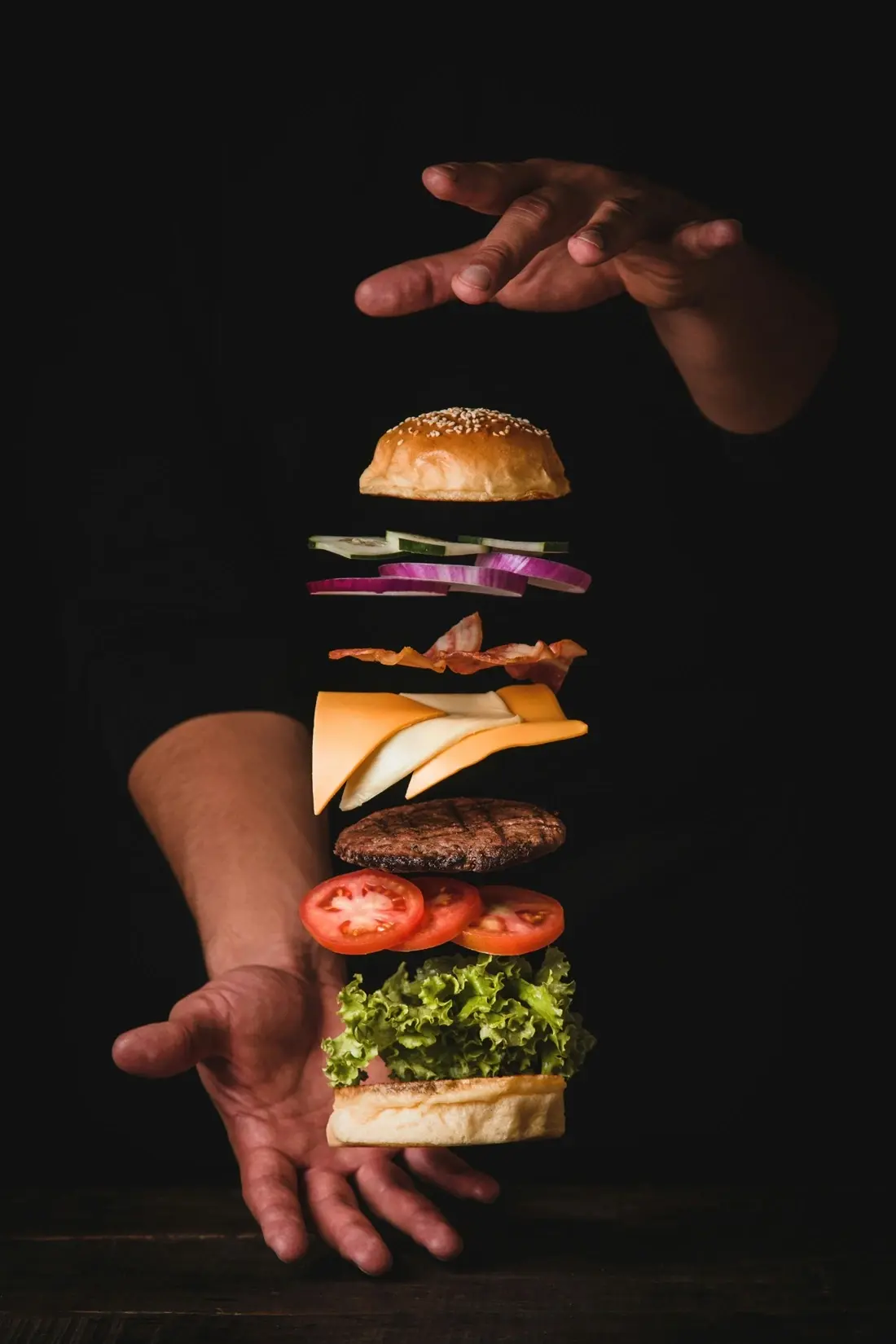
The cheeseburger has its own small legend. In either 1926 or 1928 - sources disagree - sixteen-year-old Lionel Sternberger, who worked at his father's restaurant in Pasadena, California, reportedly experimented by dropping a slice of cheese onto a patty while it was frying on the griddle. A decade later, a restaurant called Kaelin's in Kentucky officially named the sandwich a "cheeseburger," and the name was trademarked in 1935 by Louis Ballast, owner of the Humpty Dumpty Drive-In in Colorado - meaning the word "cheeseburger" is technically older than most of the people who casually use it every day.
Burgers that made it into the record books
As the burger grew into a global phenomenon, its extremes grew right along with it. The most expensive single-portion burger ever sold cost €5,000 - prepared by the Dutch restaurant The Daltons in 2021, during the pandemic, after its owner, waiting through a quiet shift, decided to try breaking the record just to see if he could. The largest burger ever cooked, assembled in 2017 in Germany by six German chefs - fittingly, in the country whose city gave the burger its name - weighed in at over 1,164 kilograms, roughly the weight of an adult walrus.
At the other end of the spectrum, speed-eating has become its own discipline: the record for most burgers eaten in one minute stands at five, while one man in Wisconsin has spent half a century logging every single Big Mac he's ever eaten - the count now runs into the tens of thousands, since his first one back in 1974.
A sandwich that outlived all its own legends
Perhaps the most striking thing about the burger is that its murky, contested history never once slowed its rise. With no patent, no single name to pin the credit on, and no official "inventor" anywhere to erect a statue to, the burger grew from a humble fairground stand into a sandwich now eaten on every continent, in countless variations - from the classic American version with pickles to local interpretations that swap in lamb, vegetables, or seafood instead of beef.
In that sense, its story might be the most American story food can tell: a murky origin, a handful of competing legends, and an eventual triumph that arrived not through one stroke of genius, but through thousands of small refinements that, generation after generation, carried ground meat between two slices of bread to where it stands today - in practically every city on the planet.