
Dubai Defies Reality Once Again: Step Inside the ‘European’ Kingdom Built on Sand
![[object Object]](https://api.hedonistmagazine.net/storage/images/2025/12/51ec952f-84b1-4876-b164-4c5452f6883f.webp)
It’s a spotless day in the Persian Gulf and I am squinting my eyes to try to see the Falkland Islands. If the information gleaned from Google Maps is correct, they should be about 50 degrees to my right and one mile away, making them just about visible without my having to leave my private pool.
Presumably, this is the kind of geographical sleight of hand that Dubai’s rulers had in mind when they first unveiled the concept of the World Islands: a vast network of 300 artificial islands floating around three miles off the coast of Dubai and assembled in a way to resemble a map of the world (or at least a map of the world sketched from memory on a cocktail napkin).
From the second they were announced, the islands became catnip to some of the world’s most ambitious developers. At one point, there were plans to turn individual islands into themed resorts and Las Vegas-style attractions, including a replica Giant’s Causeway on Ireland, a faithful recreation of the iconic Shanghai skyline, a network of Venetian canals, and a fashion-themed island under the supervision of Karl Lagerfeld.
Dubai’s state-backed developers would succeed in building the islands, dredging up some 320 million cubic metres of sand (enough to fill Wembley Stadium almost 100 times over in the process). But the bigger plans would be derailed by the global financial crash of 2008. Several individuals connected to the islands went bankrupt, with one being thrown in jail for dodgy cheques. In 2011, a lawyer for Nakheel Properties, the Dubai-based group overseeing the islands, admitted that the project was “in a coma”.
For years, the islands sat dormant, their only real purpose being to provide an interesting view for tourists flying in and out of Dubai International Airport. But over the past decade, they have begun slowly – perhaps even glacially – to return to life, thanks, in part, to a handful of plucky developers who refused to give up the original vision.
The Heart of Europe – in Dubai
Some of them have been in it for the long haul. The Austrian developer Josef Kleindienst – a former police officer who made his fortune in the early 2000s Dubai property market – first purchased the island representing his homeland in 2007. Having got the bug, he then decided to purchase five more: Sweden, Switzerland, Germany, Monaco and St Petersburg.
Almost 20 years later, Kleindienst’s dream is coming to fruition with something he calls “the Heart of Europe” – a continental-themed resort combining hotels and high-end private residences spread over several islands and connected via speedboats whizzing back and forth from Dubai.
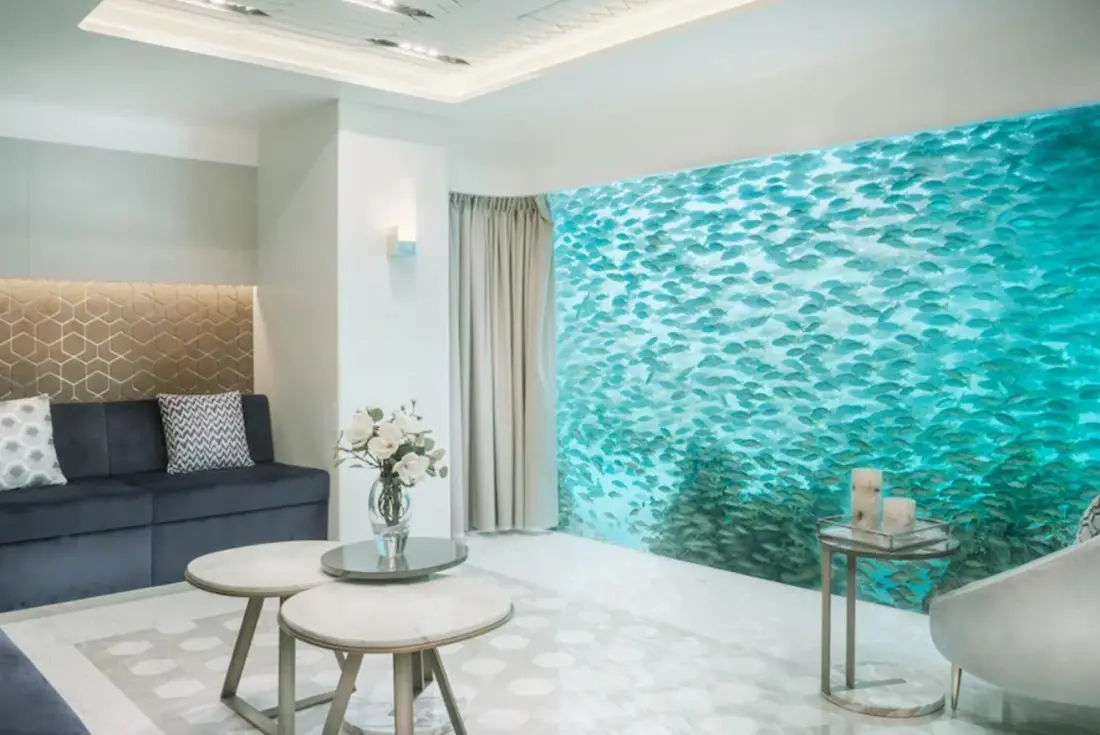
Kleindienst would be the first to admit that the Heart of Europe is still a work in progress. But what he has managed to build so far is quite remarkable. During a tour around the islands, I visit a stupendous private palace, Sweden House, with its roof inspired by a Viking boat and surrounded by a decidedly un-Scandinavian private jungle, as well as a sci-fi submerged villa where you can watch fish swim by from the master bedroom or enjoy an outdoor jacuzzi.
Like its namesake continent, the Heart of Europe doesn’t cater just to the ultra rich. Just over the water from the private residences sits the Europe-themed hotel complex. The first of several properties in development opened last year: a 200-room Monaco-inspired hotel (Voco Monaco) currently operated by the British hotel giant IHG.
Unfortunately for those who love a good novelty hotel, the Monaco theme is pretty subtle. But the hotel does have a decent French brasserie restaurant and an impressively sultry cabaret lounge. The fact that you can smoke in the latter adds somewhat to the decadent Gallic vibe.
The resort’s big attraction – at least on social media – is its artificial “raining street”, where revellers can enjoy a fake downpour every 15 minutes thanks to a hidden sprinkler system. As I sit under one of the outdoor tables finishing my afternoon pint, I’m impressed by how lifelike it feels. In the 95F (35C) heat, the water instantly creates a pleasing mist.
The resort has been popular with European expats, many of whom come for the weekend-long mini-festivals. When I visit on a Friday afternoon, the hotel swimming pool is already teeming with revellers, as a DJ pumps out repetitive techno music. The nearby bar is stocked with huge bottles of Grey Goose vodka.
Mimicking the Maldives
Four miles to the west of the Heart of Europe, it’s a much more relaxed vibe. When the United Arab Emirates-based developer Seven Tides first purchased 10 islands in the late 2000s, it promised to open a series of high-end resorts. The plans would be delayed by the crash, but not abandoned entirely: in 2021, it finally announced a hotel partner for the first resort.
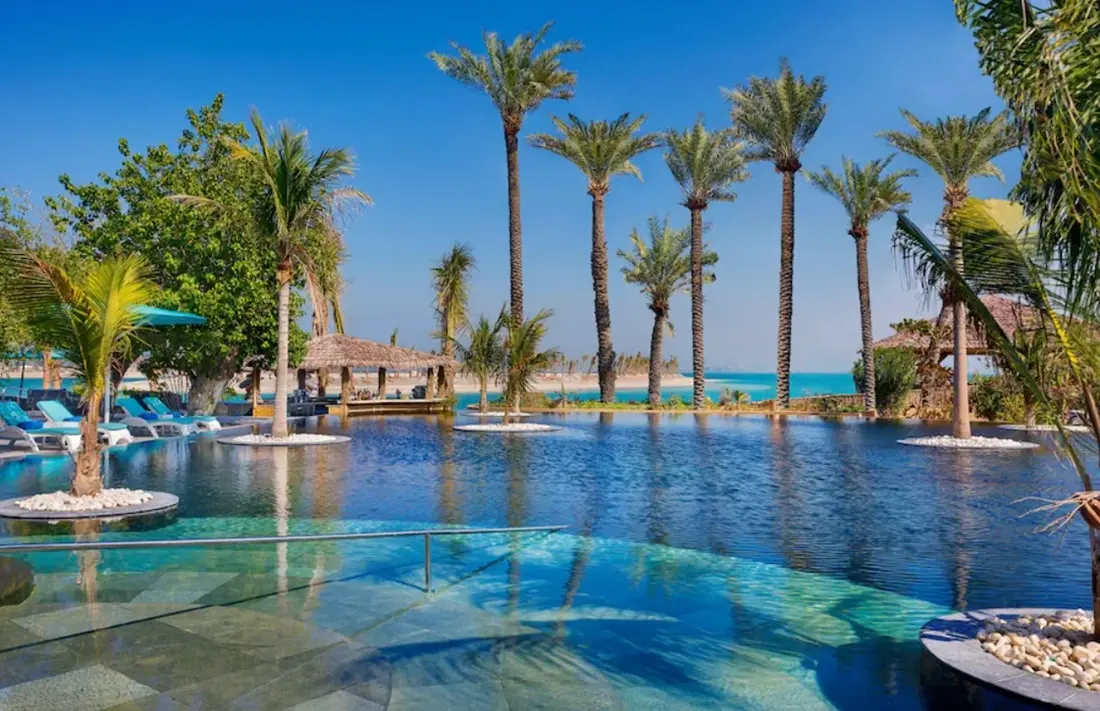
The resort in question, the Anantara World Islands, had its soft launch in 2022, and now caters to a mixture of locals and international tourists seeking a high-end fly-and-flop. With its beachside villas and private pools, it feels very Maldives-inspired, though one staffer tells me they tend to shy away from the comparison – largely because of the artificial nature of the beach.
Where the resort can compete with its south Asian rivals, though, is in the little luxury touches. Not only can guests choose from a menu of suitably exotic-sounding pampering treatments, but they can also opt to have their breakfast served in their own private pool.
Unlike the Heart of Europe, the Anantara World Islands doesn’t have any geographical theming. Then again, it isn’t as though the original location left much room for inspiration, given that the resort sits equidistant between the Falklands and the even more obscure Clarence Island. But that doesn’t seem to have held it back when it comes to attracting expats and UAE nationals keen to get a break from the high-octane side of Dubai.
A private palace on Greenland
Could this be the start of a new era for the World Islands? Maybe – but there’s still a long way to go. Travelling back from the Heart of Europe by boat, I’m struck by just how many of the sheer number of empty landmasses we pass. Looking back, it seems incredible that anyone spent $14bn (£10.6bn) on dredging these things up in the first place.
There are some signs of life: the Dubai-based party venue Soho Garden has started running special events on what used to be Chile. The UAE-based property developer Zaya has begun selling private villas on what it has since rebranded Zuhha Island. Only four out of the 30 planned villas have yet to find a buyer.
Then there’s the first resident of the World Islands, Dubai’s all-powerful ruler, Sheikh Mohammed bin Rashid Al Maktoum, who ordered the construction of his own private palace on the Greenland island in 2011. At times, it looked like he might end up being the only resident across the entire 12,350-acre development. Now, it seems he will have some neighbours after all.
That’s the thing about Dubai: it has a way of defying the doubts. The World Islands may be mad, impractical, expensive and massively delayed, but would you really want to bet against them at this point? As I watch the beachfront villas shrink as my speedboat heads back to the mainland, I don’t think I would.