
Santa Claus Has a Russian Name and an American Suit: Before Coca-Cola, He Wore Yellow, Green and Blue


The story of a coat that spent a century and a half searching for its colour – and of how two versions of Santa Claus ended up side by side in the same shop window.
Every December, the same "fact" comes back: Santa is red because red is the colour of Coca-Cola. The advertisement, they say, took him, dressed him, and sent him out into the world. What is most interesting is that an outsider doesn't refute this story, but the company itself does. On its history page, Coca-Cola says Santa Claus wore a red coat before Haddon Sundblom painted him.
If red was not brought by advertising, where did it come from?
Dressed in Fur, Not in Red
The poem that set it all in motion, "A Visit from St. Nicholas", was published anonymously in the Troy Sentinel on 23 December 1823 and is attributed to Clement Clarke Moore. Its St. Nicholas is round and jolly, with cheeks like roses, a nose like a cherry and a beard as white as snow. He is, the verse says, "dressed all in fur, from his head to his foot". Not a word about the colour of the coat.
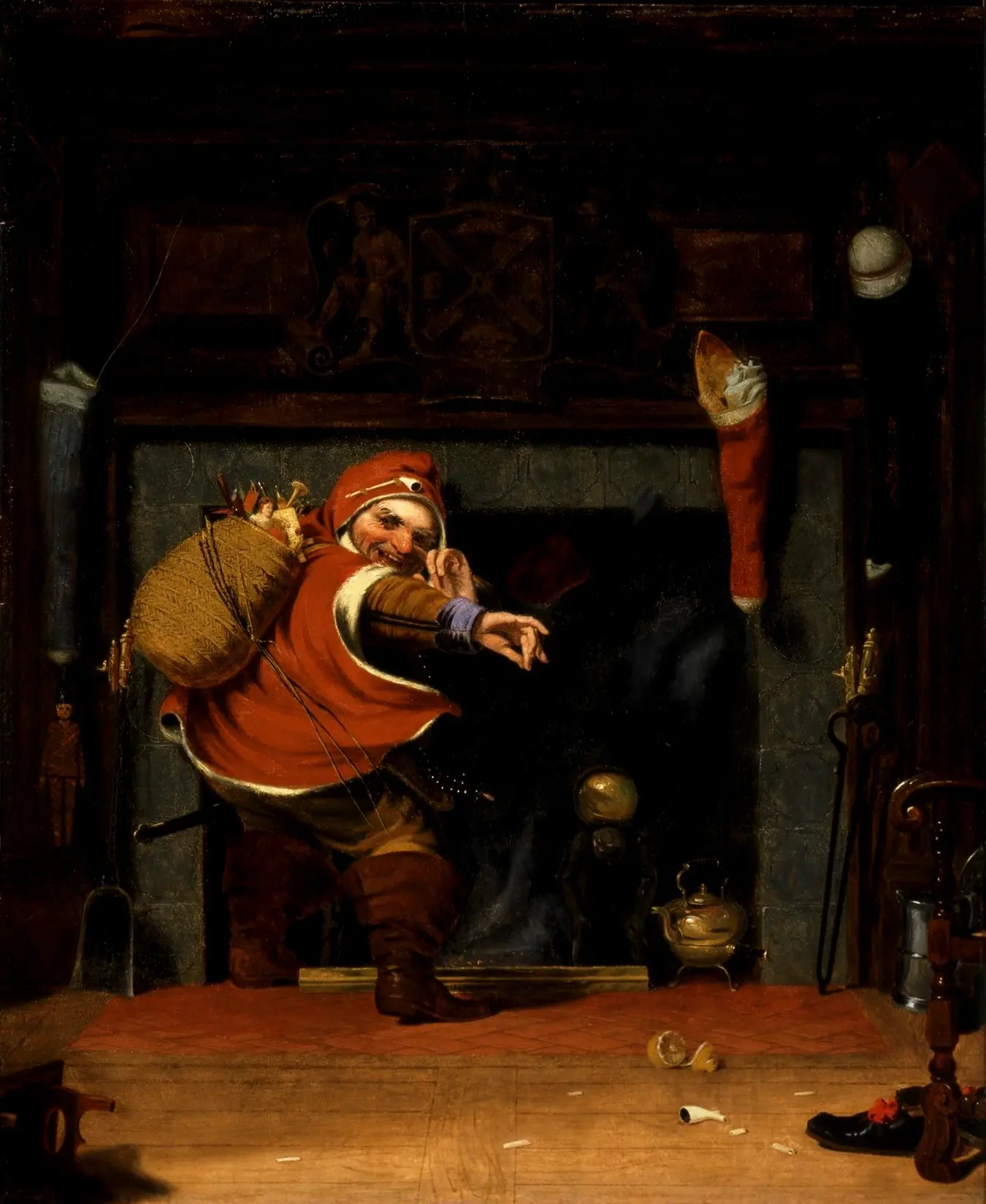
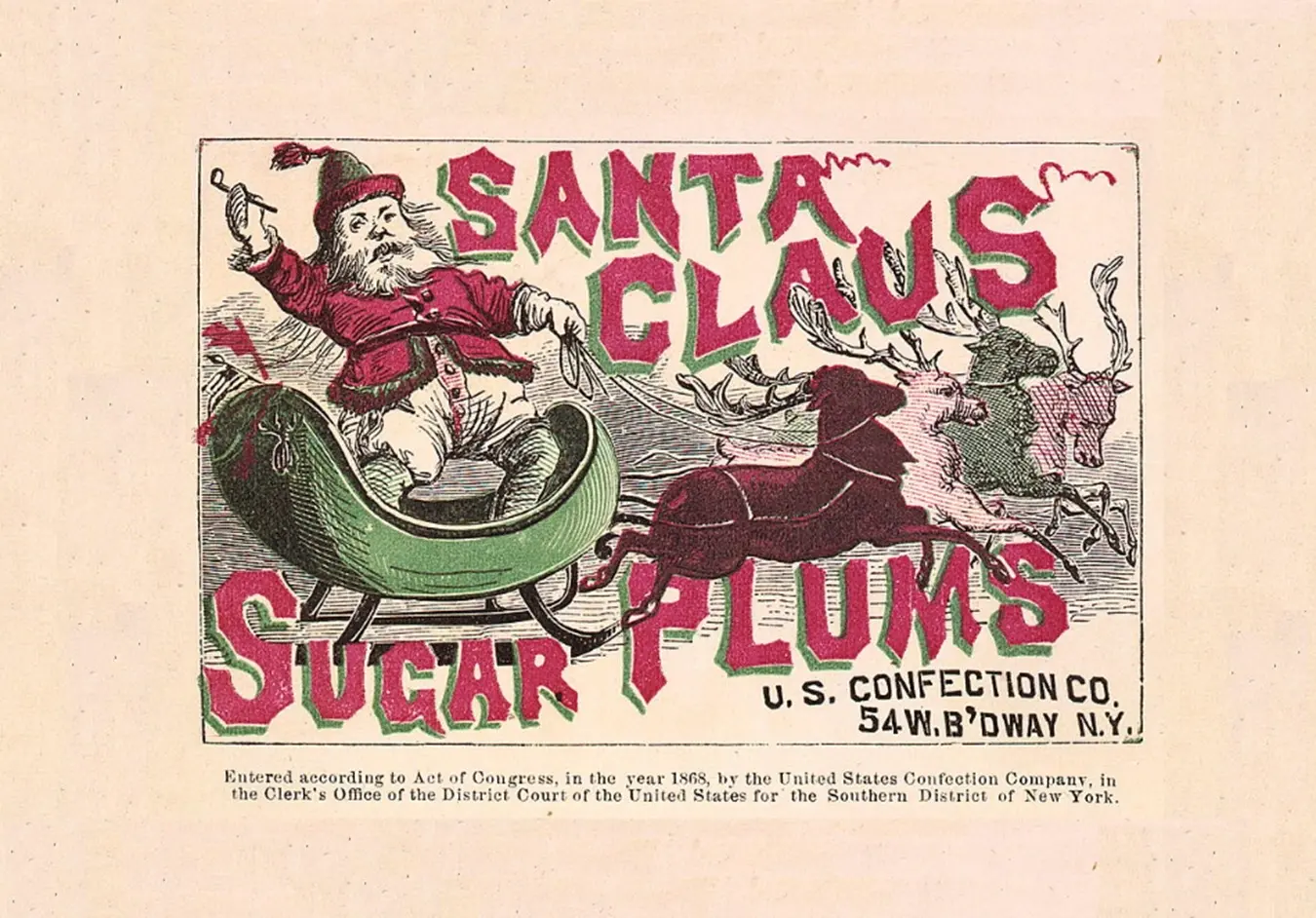
Illustrators were therefore given a free hand, and they used it generously. A painting by Robert Walter Weir from 1837 shows him in a red cloak lined with fur, an 1864 edition of the poem dresses him in yellow, and an 1868 advertisement for Santa Claus Sugar Plums gives him a red jacket and a green hat. According to the Public Domain Review, he looks as if he forgot his trousers.
An Emigrant, a Puppet and Black-and-White Print
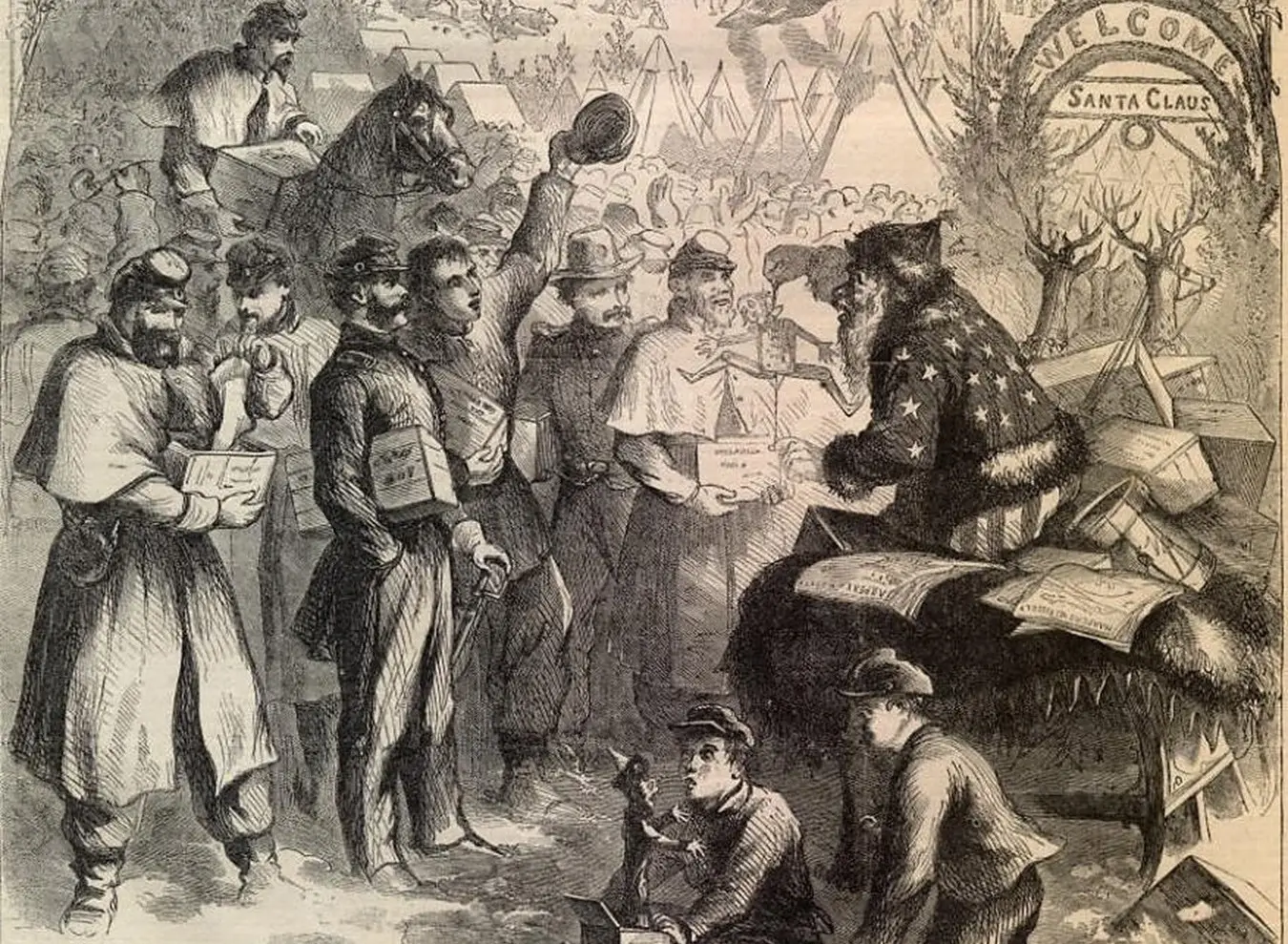
The first to give Santa a personality was Thomas Nast, a cartoonist born in Landau, then in Bavaria, whose family emigrated to America in 1846. On 3 January 1863, Harper's Weekly published his drawing of Santa handing out presents to Union soldiers in camp. He wears a blue jacket with white stars and trousers in red-and-white stripes, because this was wartime propaganda. Among the gifts, according to Britannica, is a puppet of Jefferson Davis with a noose around its neck.
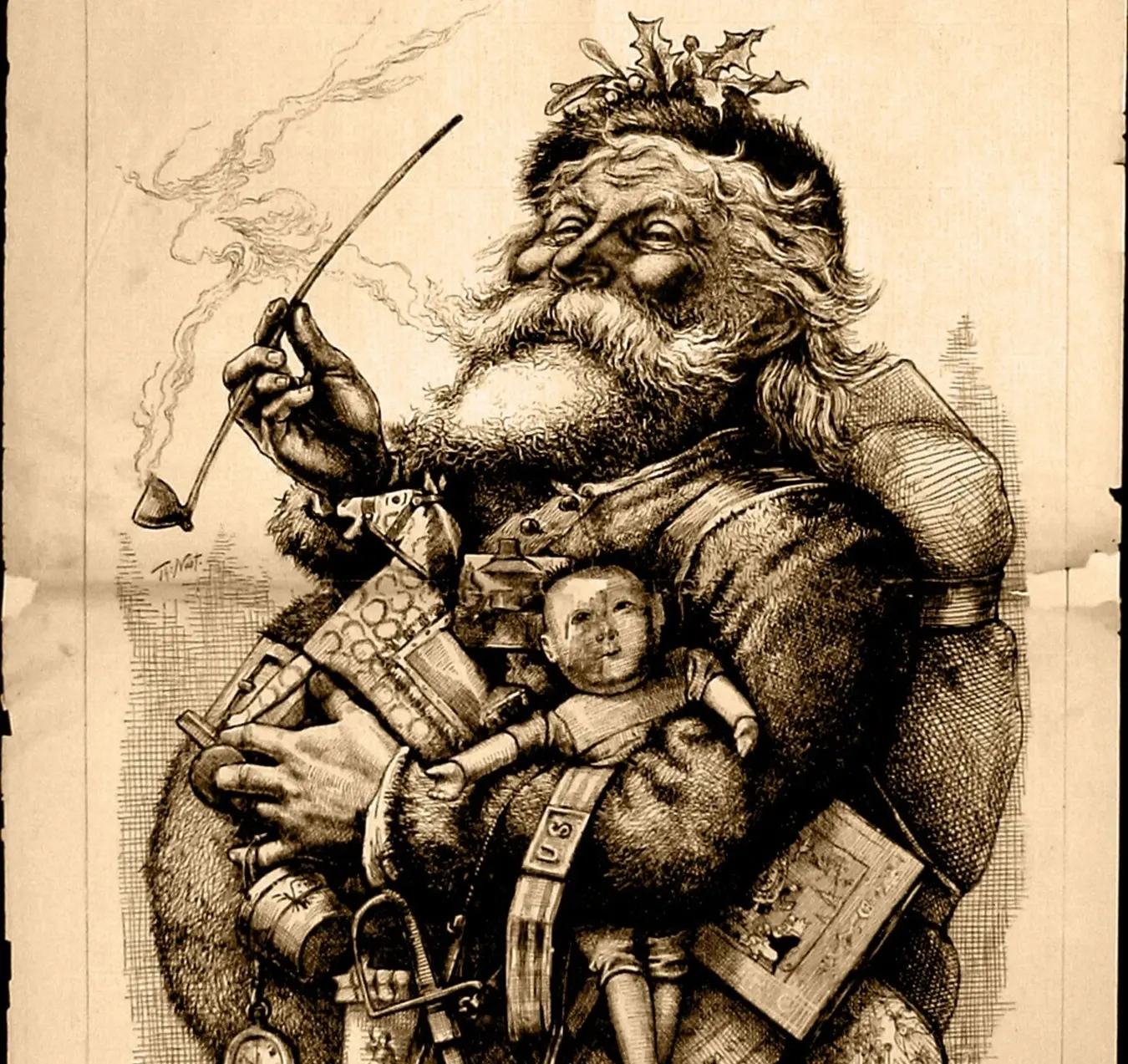
By 1886, Nast had published more than thirty Christmas drawings, and in them the figure we recognise gradually emerges: round, ruddy, with a pipe and a white beard. The most famous is "Merry Old Santa Claus" of 1 January 1881. There is, however, an interesting catch. Harper's Weekly was printed in black and white, so the colour of his coat cannot be verified from the magazine itself. Coca-Cola claims on the same page that Nast changed the coat from tan to red, but that cannot be confirmed from the black-and-white editions.
Two Santas in One Year
The year 1902 shows how unsettled things still were. That year, L. Frank Baum published The Life and Adventures of Santa Claus, whose cover shows Santa in a dark coat trimmed with leopard-print fur and red boots. On the cover of Puck dated 3 December of the same year, the Australian illustrator Frank A. Nankivell drew a Santa who, according to the Public Domain Review, is indistinguishable from today's. One Santa, then, looked like a fairy-tale hero, and the other like the figure on a chocolate box.
The second one won, and much of the credit goes to the illustrators of the Saturday Evening Post, among them J. C. Leyendecker and Norman Rockwell. By the 1930s, a red suit with white fur trim was already a standard image in American magazines.

What Coca-Cola Really Did
The company says it began its Christmas advertising in the 1920s, with a stern Santa in the manner of Thomas Nast. In 1930, Fred Mizen painted a department-store Santa in a crowd, holding a bottle of Coca-Cola, and the picture appeared in the Saturday Evening Post in December. Only in 1931 did Archie Lee, an executive at the D'Arcy agency, ask for a Santa who was both realistic and symbolic: Santa himself, not a man dressed up as Santa. The job went to Sundblom.
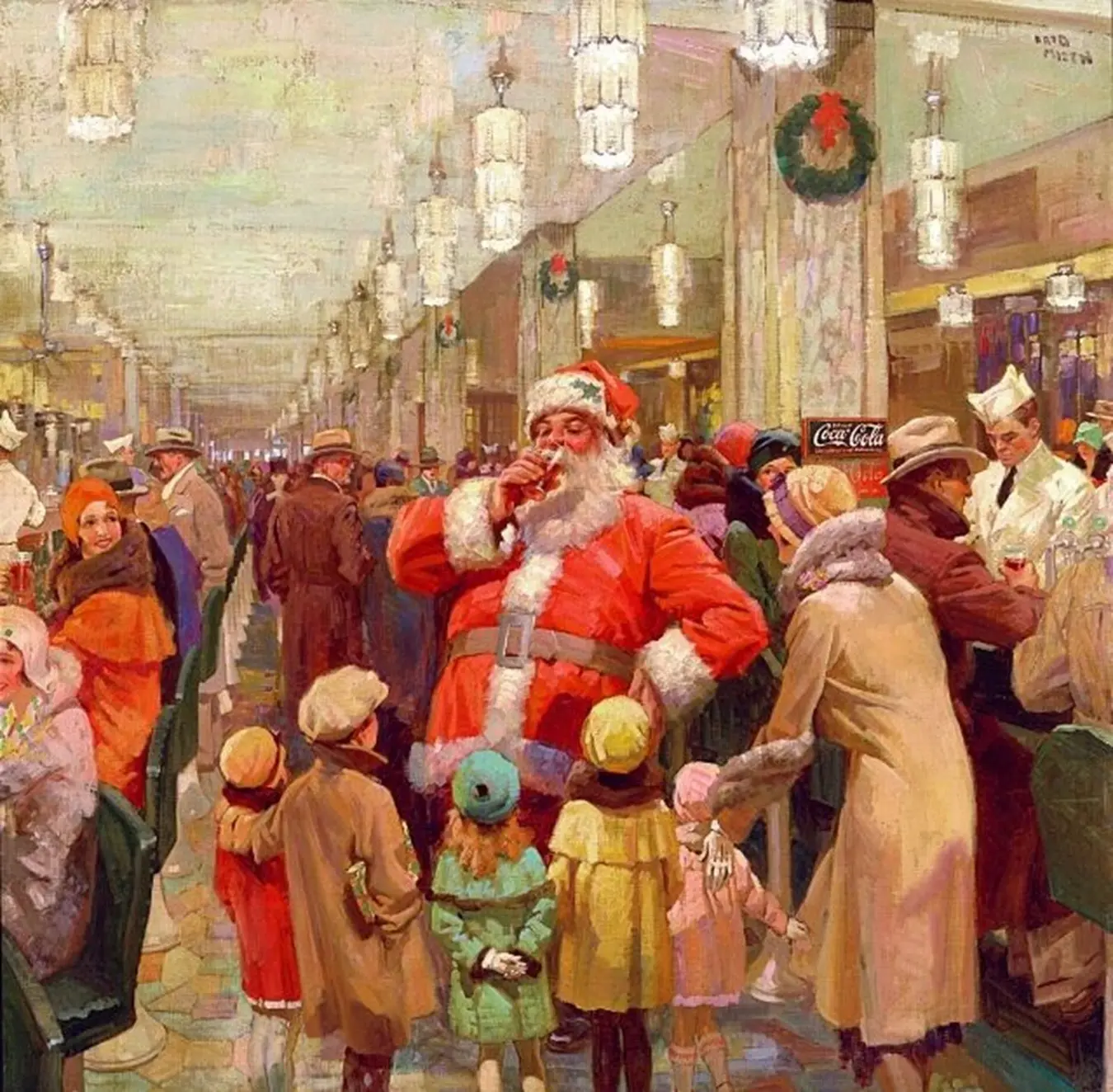
His contribution was not the colour but the face. His model was his neighbour and friend Lou Prentiss, a retired salesman. When Prentiss died, Sundblom painted himself, looking into a mirror. That is how, it is believed, one year Santa's belt ended up on backwards. Another year Santa appeared without a wedding ring, and viewers wrote to the company asking what had happened to Mrs Claus.
Sundblom painted Santa until 1964. Coca-Cola did not invent the red Santa; it ended the search for his look. What had been one possibility among many became the only face of Christmas.
And Our Deda Mraz Is Not from America at All
In our part of the world, the story takes a different route. The name Deda Mraz does not come from the Christmas tradition but from the Russian figure Ded Moroz. In Slavic folklore, this old man was originally a winter spirit who froze people and who had to be appeased with offerings to soften the winter. In popular retellings, he also carried off children, who were ransomed with gifts. By the end of the nineteenth century, he had become a good-natured figure who brings presents.
The Soviet authorities declared him an "ally of priests and kulaks" in 1928. In December 1935, Pavel Postyshev's letter in Pravda brought back the New Year tree, and with it Ded Moroz, not for Christmas but for New Year, as a figure without religious weight. He first appeared at the House of Unions in Moscow in 1937. Traditionally, he wears a red or blue coat.
After the Second World War, the new authorities in Yugoslavia sought to suppress religious customs, and following the Soviet model, they introduced a Deda Mraz who brings presents for New Year. That is why, here, his name leads to Moscow, not to Myra in Lycia, where St. Nicholas came from, or to New York.
Today we see him in shop windows almost always in red. And so we have perhaps the strangest Deda Mraz in the world: his name and his date come from Moscow, his suit from America, and nobody asks him anymore where he came from.