

Salt: The Only Rock Humans Eat
![[object Object]](https://api.hedonistmagazine.net/storage/images/2026/10/2b29266a-7442-427b-9116-885aadc50850.webp)
Of all the minerals on the planet - and there are thousands, from quartz to diamond - only one does a human deliberately put directly into their mouth every day, in enormous quantities. Salt, chemically halite, is the only rock that isn't a decoration, a tool, or a building material, but an ingredient.
And not just any ingredient - unlike almost everything else we eat, it shows up in literally every cuisine on the planet, with no known exceptions. There is no people, religion, or culture that has fully removed it from its diet.
A Craving Nobody Had to Learn
What sets salt apart from the other tastes we enjoy - sweet, bitter, spicy - is that the craving for it isn't a learned habit, but a built-in biological command. American physiologist Curt Richter proved this best back in the 1930s, through a series of experiments now considered classics of behavioural physiology. Richter surgically removed the adrenal glands from rats, inducing a condition in which the body loses salt far faster than normal and dies dangerously quickly without replenishment. The rats, with no prior training or experience whatsoever, changed their own diet - choosing, from the options available, exactly the ones rich in sodium, in amounts sufficient to literally save their lives. Nobody taught them to do this. In the most literal sense, their bodies knew what they were missing.
In humans, the mechanism works similarly, just more subtly - the body regulates sodium levels in the blood within an extremely narrow range, since salt is essential for nerve function, muscle contraction, and fluid balance. Without it, there is, quite literally, no life. That biological necessity is exactly why salt, unlike the spices a person adds purely for pleasure, appears in the diet of every human civilization that has ever existed.
The Myth That Named Our Paychecks
That same irreplaceability also made salt the subject of one of the most enduring etymological legends in the world - the story that the English word "salary" comes from the Latin salarium, supposedly the amount Roman legionaries received in the form of salt. The story sounds convincing precisely because salt really was precious, and the word salarium really does come from sal, salt. The trouble is, as historians of antiquity have repeatedly established, no ancient source confirms that soldiers ever literally received sacks of salt instead of money. The salarium was most likely a cash allowance meant for buying salt on top of regular pay - much like someone today might receive a transport allowance rather than actual transport. Even the Roman writer Pliny the Elder, often cited as the source of the story, never wrote that soldiers were paid in salt - he merely noted that the term derived from how important the product was. The etymology, then, is real. The image of a legionary receiving a sack of salt instead of coins is, most likely, a myth that survived simply because it's too good to check.
When a Tax on Salt Brought Down an Empire
If the Roman salt myth was harmless, the British salt tax in India was anything but. The Salt Act of 1882 gave the British Crown a monopoly over the production and sale of salt across the Indian subcontinent, banning the local population from producing salt themselves - even when they lived right by the sea, where salt was literally evaporating out of the water. At one point, the salt tax accounted for 8.2 percent of the British administration's total tax revenue in India, and it hit the poorest the hardest - people for whom salt, precisely because of that same biological necessity, was essential no matter the price.
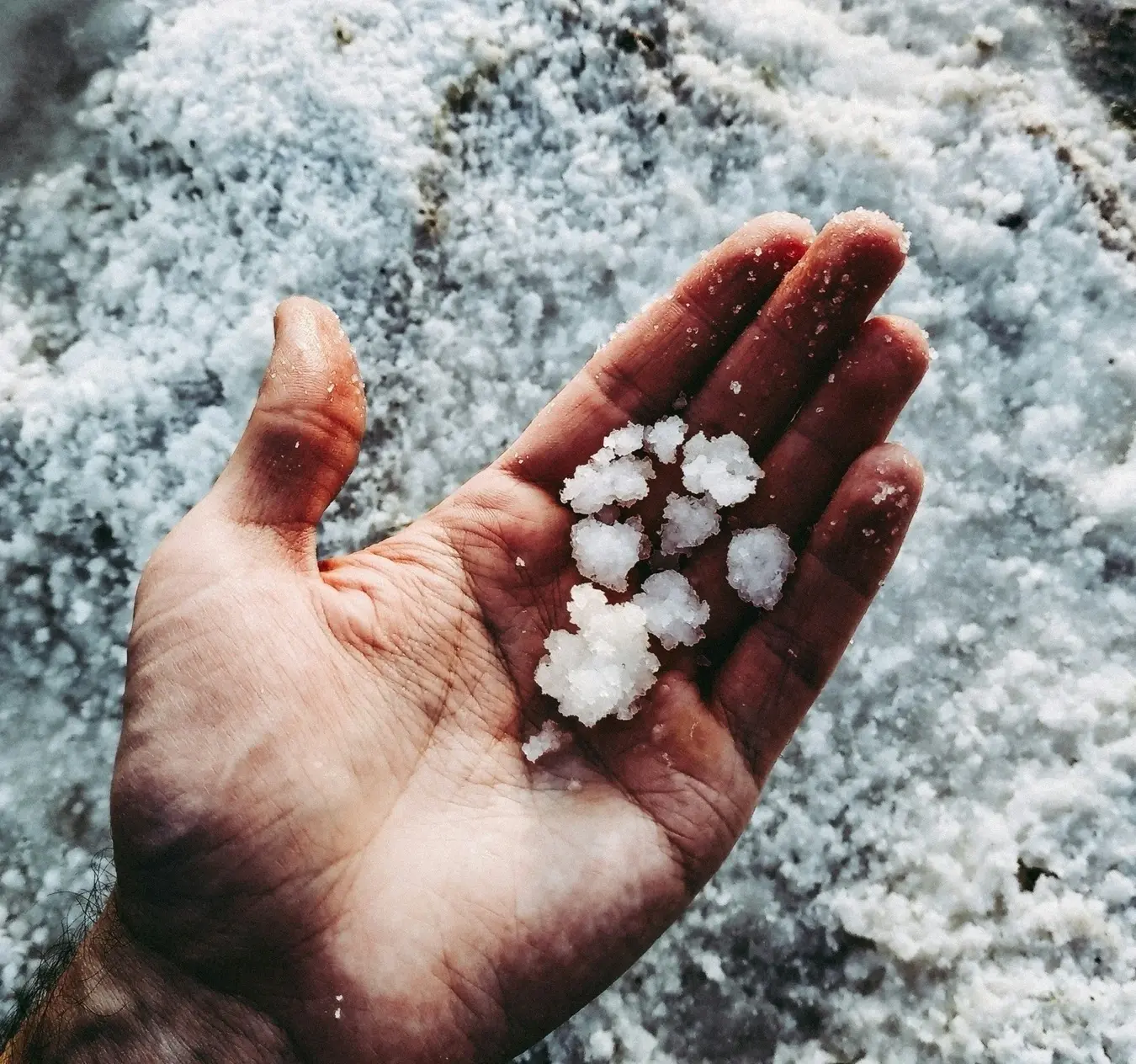
In 1930, at sixty-one years old, Mahatma Gandhi set out on foot from the Sabarmati Ashram toward the coastal village of Dandi, accompanied by roughly seventy followers. Twenty-four days and more than three hundred and eighty kilometres later, on the shore of the Arabian Sea, he bent down, picked up a handful of naturally evaporated sea salt, and in doing so broke the law in full view of the entire world. That almost symbolically simple gesture - a man picking up salt from a beach where it had always been - set off a wave of civil disobedience that saw nearly sixty thousand people jailed by the end of that year, and is today considered one of the turning points on the road to Indian independence. It wasn't war or revolution that shook the empire. It was the sight of one thin man picking up salt from a sea that no one should have been allowed to control.

The Rock We Stopped Noticing
Today, in the developed world, salt sits on a supermarket shelf at a price nobody even registers, in a bag that lasts for months for the cost of a few coins. Looking at that bag, it's hard to imagine that the same substance was once valuable enough to spawn legends about wages, strategic enough for empires to build monopolies around it, and fundamental enough to human survival that a movement built on nothing more than a handful of earth could shake a continental power. In that sense, salt might be the best reminder of just how quickly a human being forgets the value of something it always has enough of - until, if only for a moment, someone takes away the very thing that's been built into its body, since birth, as a need it never gets to choose.