
Cities Beneath Cities: Places Where History Was Preserved Underground
![[object Object]](https://api.hedonistmagazine.net/storage/images/2026/08/dcce4531-d531-4caa-952c-dfaa1e7a0b13.webp)
In 1963, a man renovating his house in the Turkish town of Derinkuyu knocked through part of a basement wall and discovered
The tunnel led to another passage, then to a staircase, and then to another level below. What he had uncovered was not a hidden room but an entire city - built not beside his house, but deep beneath it, and forgotten for centuries.
Beneath the streets of many of the world's cities lies another, parallel geography: tunnels, chambers, streets and entire communities built in darkness for reasons that were once a matter of survival - escape from persecution, plague or war. Today, we descend into these same spaces with a map in hand and a flashlight on our phones, for something far more peaceful: to experience what life was like when sunlight was something people could never afford to take for granted.
Derinkuyu, Turkey - A City Built for 20,000 People, Designed to Disappear
Derinkuyu, in the heart of Cappadocia, is one of the largest and deepest among more than 200 known underground complexes in the region. Eight levels, reaching roughly 50 metres below the surface, are currently open to visitors. At the same time, the entire complex is believed, according to various studies and estimates, to extend as deep as 85 metres. That could mean as many as eighteen levels in total, although the lower sections remain unexplored or closed to the public. The soft volcanic stone of the region, known as tuff, was easy enough to carve with simple tools yet durable enough to survive for millennia.
The exact origins of the city remain uncertain. Some researchers attribute the earliest excavation to peoples living in the region as far back as the Iron Age, but there is no firm consensus on a precise date of construction. What is more certain is that Derinkuyu took on its elaborate final form much later, when early Christians fleeing persecution during the Byzantine era expanded existing tunnels into a fully functioning underground city - complete with livestock stables, wineries, kitchens, schools and even a church on the lowest level. In times of danger, massive stone doors, weighing several hundred kilograms, could be rolled across passageways to seal entire sections from the inside. A system of more than fifty ventilation shafts, some reaching depths of 55 metres, provided the underground settlement with fresh air and access to water even when the entrance at the surface was completely blocked.
The city was abandoned in 1923, when the Greek Orthodox population of Cappadocia, which had been among its last inhabitants to use it as a refuge, was forcibly displaced from Turkey. After its accidental rediscovery in 1963, only part of Derinkuyu was opened to the public, first in 1965. Today, visitors can take a tour lasting around 90 minutes, covering roughly half of the levels that have been explored. Tickets cost around $45, while the nearest major airport is in Kayseri, approximately a 90-minute drive away. Visitors with claustrophobia or breathing difficulties are generally advised to avoid the narrowest sections, where passages can at times shrink to little more than shoulder width.
The Paris Catacombs - A City of Bones Beneath the City of Light
Beneath Paris lies a network of abandoned limestone quarries stretching for more than 300 kilometres - roughly the equivalent of building an entire Paris Metro system underground without a single station at street level. The official visitor route covers only a tiny fraction of that network, around 1.5 kilometres at a depth of roughly 20 metres. Yet this small section is known for something far darker than the original purpose of the tunnels: it is one of Europe's largest ossuaries, holding the remains of more than six million people.
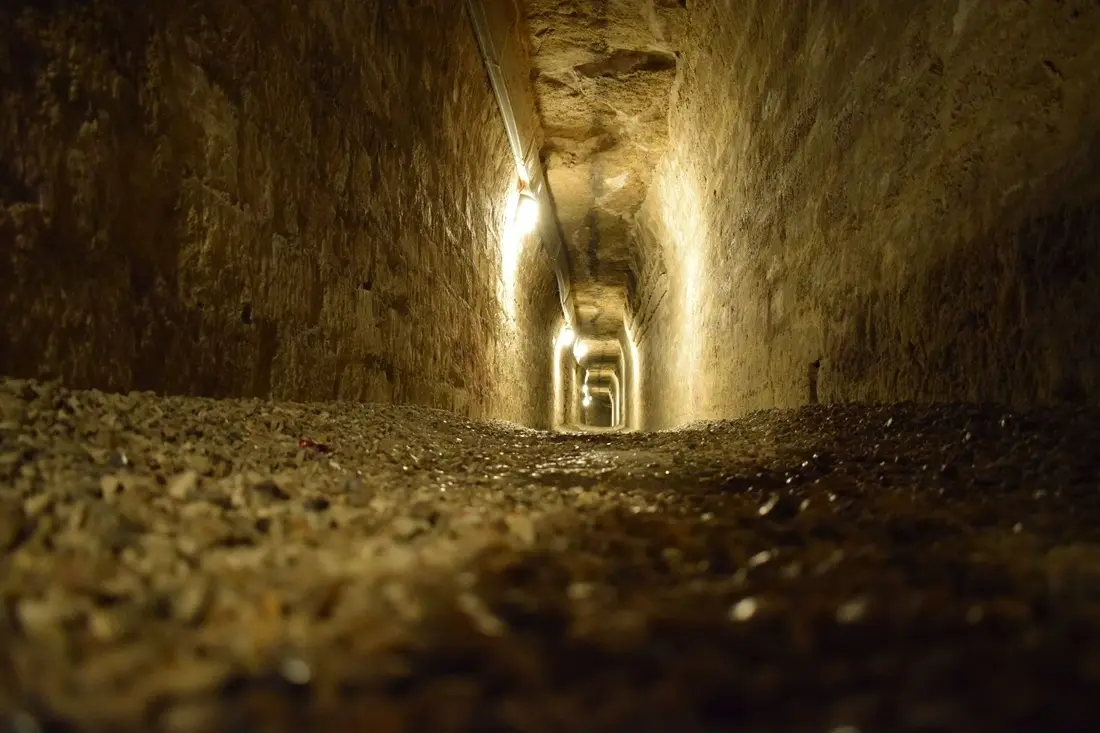
The story begins in the late eighteenth century, when Parisian cemeteries, overcrowded after centuries of burials, began literally spilling into neighbouring streets and cellars. Decay contaminated wells, while cemetery walls occasionally collapsed under the weight of accumulated bodies. The solution was found underground, in the abandoned limestone quarries that had supplied the stone used to build the city itself. Beginning in 1786, Parisians who had been buried for centuries were moved, skeleton by skeleton, beneath the city they had once inhabited. The transfers took place in nocturnal processions accompanied by priests and lasted fifteen months for the first major phase alone.
What began as a practical response to a public-health crisis had, by 1810, evolved into something far stranger. Inspector Éricart de Thury began arranging the bones into deliberate, almost artistic compositions - walls made from alternating rows of skulls and leg bones, columns, altars and even a heart formed entirely from skulls. The site was opened to the public in 1809, initially by appointment, making the catacombs one of the earliest tourist attractions of the modern era, at a time when Europe's fascination with death and the Gothic was becoming deeply embedded in popular culture. Revolutionary figures Jean-Paul Marat and Maximilien Robespierre are believed to rest somewhere within these walls, mixed among the remains of ordinary Parisians.
Today, the catacombs receive more than half a million visitors each year. The official tour takes around 45 minutes, descends roughly a hundred steps and follows approximately two kilometres of tunnels, where the temperature remains around 14°C year-round. It can feel cold even in summer, making a jacket advisable regardless of the season. Beyond the official visitor route, the wider network continues to attract so-called cataphiles - illegal explorers who venture into restricted sections of the labyrinth, sometimes spending days underground.
Mary King's Close, Edinburgh - The Street the City Swallowed
Unlike Derinkuyu and the Paris Catacombs, this was neither a tunnel nor a quarry. It was an ordinary street, lined with houses and shops and inhabited by ordinary people. Edinburgh's Old Town, built along a steep volcanic ridge and confined within defensive walls, had little room to expand outward. Buildings therefore grew taller, while the poorest residents were pushed into the lowest, dampest and darkest parts of these increasingly crowded structures, close to the ground.
One of these narrow closes, Mary King's Close, was named in 1630 after a cloth merchant who continued running her business there following her husband's death. Just fifteen years later, in 1645, Edinburgh suffered the worst outbreak of plague in its history, hitting this part of the city particularly hard. Overcrowded, poorly ventilated closes without proper sanitation provided ideal conditions for disease, and estimates suggest that between one-fifth and one-half of the city's population died. According to local legend, some infected residents were walled into their homes alive in an attempt to prevent the disease from spreading - a story treated cautiously by historians but deeply embedded in the identity of the site.
By the middle of the eighteenth century, the close was partially demolished and covered by new construction. The Royal Exchange was built above it, on the site now occupied by Edinburgh's City Chambers, while what remained of the original houses was simply sealed beneath the new foundations and disappeared from memory for more than a century. The last residents moved out in the early twentieth century, after which the authorities closed the space. Decades later, archaeologists rediscovered it and established just how much of the original street had survived - not reconstructed, but preserved, with the same stone thresholds once crossed by residents of seventeenth-century Edinburgh.
Today, Mary King's Close can only be visited as part of a guided tour, lasting around an hour and beginning directly from the Royal Mile, the principal street of Edinburgh's Old Town. Guides, often in period costume, bring to life the stories of the people who once lived and died there. One of the site's best-known modern legends concerns a girl named Annie. According to a story still recounted by the site's official visitor organisation, Japanese psychic Aiko Gibo claimed in 1992 that she sensed the presence of a child who had died of plague in one of the rooms. Ever since, the room has become an unofficial place of pilgrimage, with visitors continuing to leave toys for her.