

Your Style, Someone Else’s Data: Who Really Chooses What You Wear?

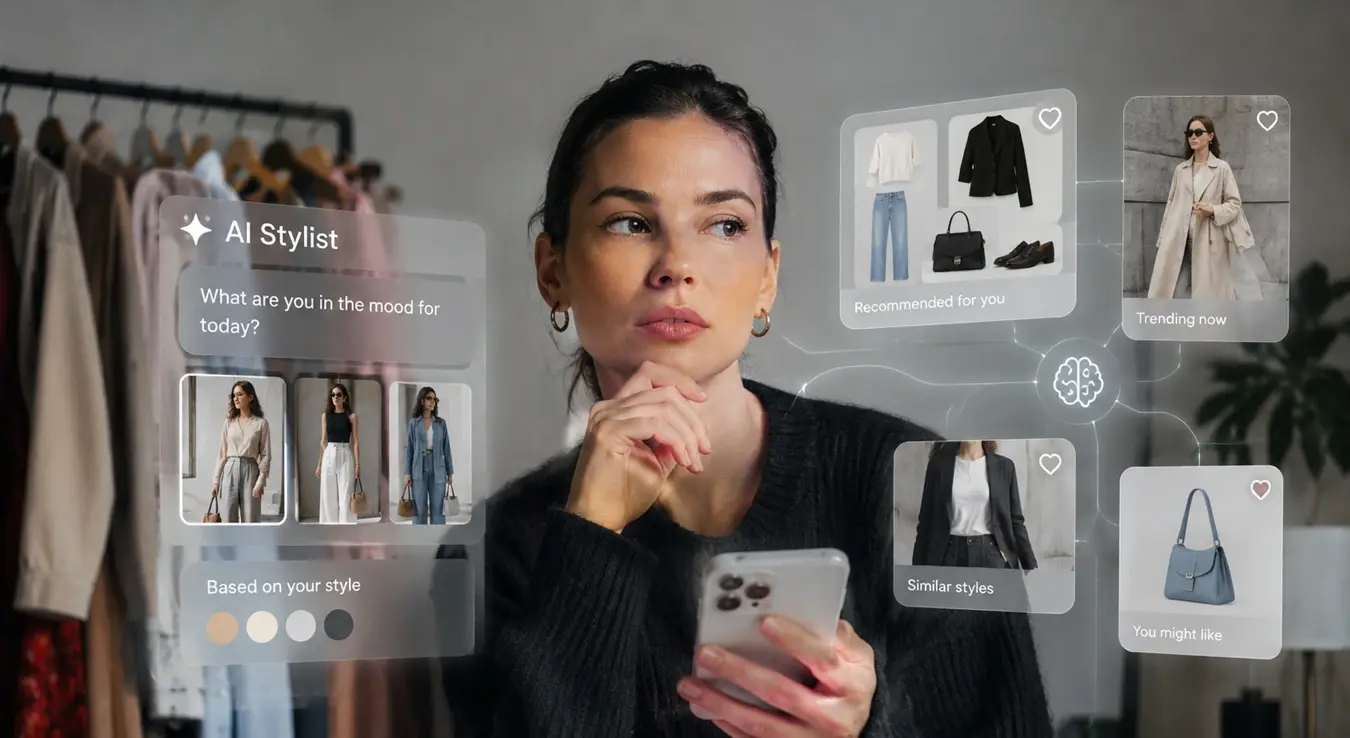
Algorithms no longer recommend films and songs. They have moved into the wardrobe, from the feed to the AI stylist in an app. What do we actually know about the effect, and is taste still ours?
In April 2017, Amazon unveiled a camera for the bedroom, the Echo Look, that rated your outfits. Its Style Check feature compared two combinations and picked the better one, using machine learning and human “fashion specialists.” Three years later, Amazon discontinued the device, and the style advice moved into its shopping app. The idea did not die. It just no longer required you to buy a camera and put it in your room.
A Feedback Loop at the Fashion House
The clearest example is Shein. According to industry analyses, new designs launch in test runs of 100 to 200 pieces, and the company tracks what sells and produces only that. Estimates of how many new items it adds each day range from two thousand to ten thousand, depending on the source. As analysts describe it, the model does not ask what is good but what gets clicked, so what you are offered is, to a large degree, a reflection of what others clicked before you.
Conversational AI stylists are the newer phase. According to a survey by Vogue Adria, Zalando and ASOS have assistants to which you describe an occasion in your own words; ASOS has extended its assistant to ChatGPT, and Google offers virtual try-on. The question is no longer “what’s trending” but “what looks good on me.”

The Evidence Is Murkier Than the Headlines Claim
The best-known argument comes from Kyle Chayka’s book Filterworld: algorithms have replaced human tastemakers and flattened culture, so cafés in Brooklyn, Berlin, and Bangkok look alike. Critics fault him for setting up a false dichotomy between the algorithm and human selection, since human selection was never neutral either. The sociologist Pierre Bourdieu showed back in the 1970s that taste was never purely personal.
The empirical picture is more complicated. A study of users of the MovieLens service found that those who follow recommendations watch a wider range of films than those who ignore them. A later model explains how that can be: each person gets more variety, but everyone gets the same variety, so recommendations reduce the differences between people. Simulations show that feedback loops, in which an algorithm is trained on behavior prompted by its own recommendations, homogenize users without any benefit to them. Other analyses, however, find that prolonged exposure to recommendations narrows individual choices as well.
The answer, then, is: it depends on the system and on who is using it. The one reliable conclusion is that individuals probably have broader taste than before, but we have all broadened in the same way.
The New Middleman: The AI Adviser
If you are skeptical of the feed, it may be a mistake to treat the AI stylist as its prettier successor. An audit by economists from Harvard Business School and other institutions, covering several large language models (ChatGPT, Gemini, Claude, and others), found that in 20 of 100 product and service categories examined, the models put the same single product in first place in more than three-quarters of their answers. A study by the ARF finds that AI tools often repeat a narrow circle of familiar brands.

But the picture is not one-sided. According to research by the company Jellyfish, reported by WARC, a single fashion request in the US returned 120 brands, and the most frequent had only seven percent of the shelf. Different assistants presented the same products in “radically different” ways. So there is no single algorithm dictating taste, but there is a new obligation: we have to choose which adviser we listen to.
What Is Your Taste When You Measure It?
This is a question no data can answer. One interviewee in Chayka’s book wonders whether what she likes is what she really likes, because Pinterest and Instagram have shaped her eye. That unease is probably more accurate than any statistic.
In practice, a good test is what you already wear. The ten pieces you have been pulling out of the wardrobe for years show your real preferences, because no click shaped them. That is data no algorithm has.
So, three small habits. Before buying, ask yourself where you first saw the item, and if the answer is a feed, wait. Second, seek recommendations from a source with a human voice, whether that is a shop, a tailor, or secondhand clothing. Third, if you use an AI stylist, ask it to build around what you already love rather than to replace it.
Taste was never only ours. The difference is that nobody used to measure it in real time.