

The Quietest Room in the World: What We Hear When Everything Else Disappears

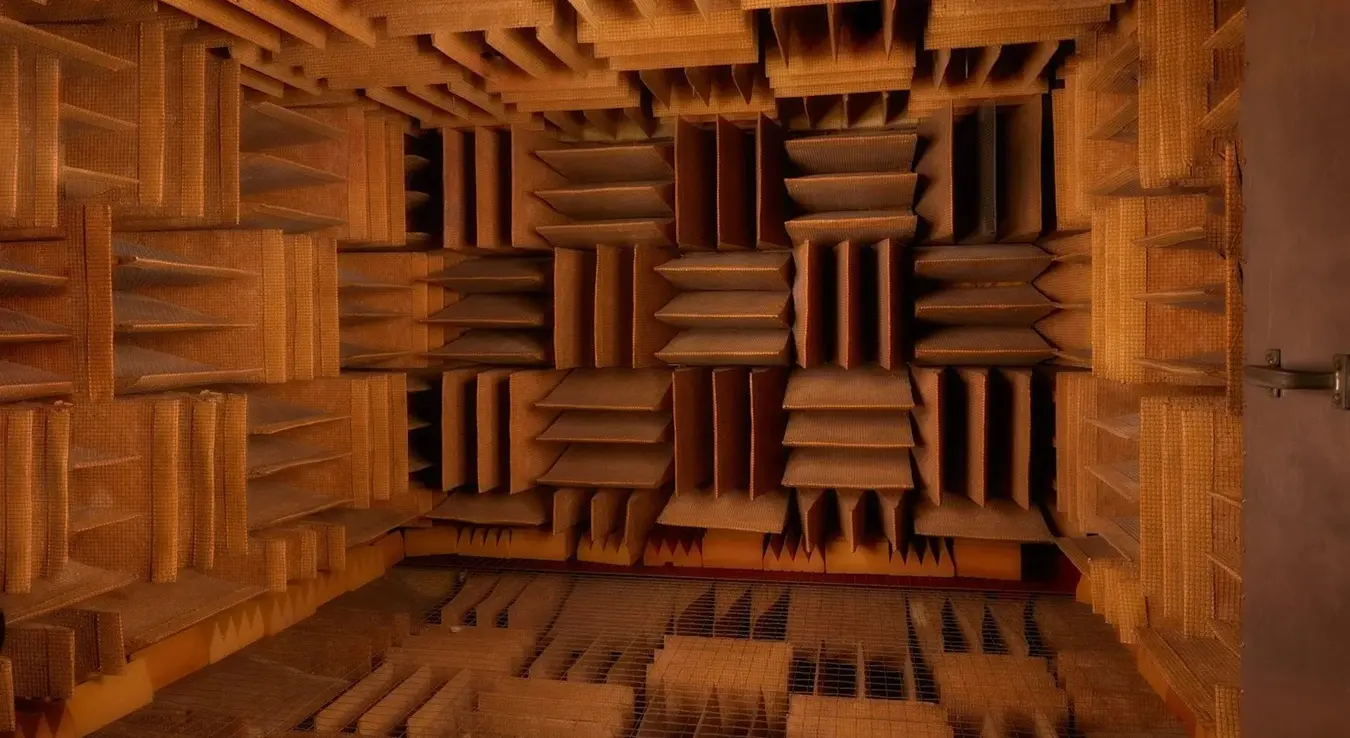
The story goes that no one can last in it longer than 45 minutes. The room’s owner says the line is a myth, and one journalist spent three hours in the dark.
In 1951, the composer John Cage walked into an anechoic chamber at Harvard expecting silence. He stood on a platform suspended from steel cables, surrounded by some 20,000 fiberglass wedges that swallow every echo. He heard two sounds, one high and one low. The engineer in charge explained that the high one was his nervous system at work and the low one his blood circulating. The following year, on August 29, 1952, pianist David Tudor sat down at a piano in Woodstock and, for four minutes and 33 seconds, played no notes.
The Harvard chamber was built in 1943 for the military, under the direction of the acoustician Leo Beranek, and was the first of its kind in North America. It was dismantled in 1971. Its legacy lives on in Minneapolis.
A Race into Negative Decibels
The quietest place on Earth, according to Guinness, sits in a modest concrete building in Minneapolis, at Orfield Laboratories. It has been measured at −24.9 dBA. The minus sign is not a mistake: zero decibels is roughly the limit of what the human ear can hear, and a whisper is about 30 decibels. In that room, the background noise lies below the threshold of human hearing.
The record was first set here in 2004 at −9.4 dBA, improved in 2012 to −13, and lost in 2015 to Microsoft’s chamber in Redmond, which Guinness measured at −20.35 dBA (its builder cites −20.6). Orfield took it back on November 19, 2021, and, according to the latest available information, still holds it.
The room is a steel cube, roughly 12 by 10 by 7 feet (3.7 by 3 by 2.1 meters), lined on all six sides with fiberglass wedges nearly a meter long. It floats inside a second steel box, set on beams above enormous springs. It was built in the 1960s by the firm Eckel for the appliance maker Sunbeam in Chicago. Steven Orfield bought it cheaply when the company moved its research to Japan. He disassembled it, he says, with the help of the University of Chicago football team, loaded it into three trucks, and kept it in storage for eight years. It found a home only in 1990, when he bought the building of the former Sound 80 studio, where the disco hit “Funkytown” was recorded and where Dylan re-recorded Blood on the Tracks.
What You Hear
In an ordinary room, the body is drowned out by the noise around it. Here, there is nothing to cover it. Orfield claims that after 30 to 45 minutes you can hear your own pulse and, when you move, the joints of your knees and elbows. He himself has a mechanical heart valve, and says that after half an hour he could hear it as a loud ticking. Orientation goes too: people find their way through space by how sound bounces back as they walk, and here there is nothing to bounce, so after half an hour you have to sit down.
The Myth of 45 Minutes
The story of 45 minutes began with a 2012 headline in the British tabloid the Daily Mail, according to which that was the longest anyone could bear the quietest place on Earth. It has been copied countless times since. Orfield says it appalled him, and that the quote about going mad inside was made up.
The truth is stranger. There was something called the Orfield Challenge: sitting in the dark for as long as possible. The record stood at two hours until Caity Weaver, a writer for The New York Times Magazine, spent three hours in the chamber. After about fifteen minutes, she saw her first flash of light in the dark, and she emerged feeling as if she had been to a spa. A false rumor also circulated on TikTok that the laboratory pays millions to anyone who can last an hour.
Today the chamber is a service, not a threat. One-hour group sessions for five people cost $99 in the winter of 2026, and according to Mpls.St.Paul magazine, more than 1,000 visitors from around the world went through them in the 12 months to the summer of 2025. The hip-hop musician Questlove performed for 47 minutes and has said it changed his life.
Cure or Fad?
Orfield’s granddaughter, Emma Orfield Johnston, began offering the chamber as a therapeutic experience in 2024, and the laboratory is planning, with the University of Minnesota and the VA hospital, a study of treating PTSD in veterans. The neuroscientists cited by Mpls.St.Paul speak of hypotheses, not evidence: that a complete cutoff of sensory input might push the brain to reexamine its patterns, or that associative areas of the brain might be activated.
Here, such a room is called a gluva soba, a “deaf room,” and it is used mostly to test sound. The University of Novi Sad also has a smaller chamber.
Cage later described that episode as the experience that gave his life direction: the exploration of non-intention. The room is now quieter than any engineer in 1951 could have imagined, and people still come to hear what he heard: their own bodies. Orfield says that what once looked like madness now looks like common sense.
Related articles

One Hour of Silence
There are tables for celebration and tables for negotiations. And then there are those third ones - tables for nothing in particular. They require no occasion, no reservation, no plan. It’s enough to sit down, place your phone face down, and order the first drink that comes to mind. Coffee, sparkling water, a glass of wine. It hardly matters.
Silence of the Forest as Therapy
In a world that is constantly becoming faster, louder, and permanently connected, a simple experience is quietly gaining popularity across the globe - spending time in the forest. Not as hiking, not as a sport, but as a conscious act of slowing down. The Japanese even created a term for it: Shinrin-yoku, which literally means “forest bathing.”