

How an Alien Family Became a Mirror of the 1990s
![[object Object]](https://api.hedonistmagazine.net/storage/images/2026/08/d2ac2a12-127f-47cb-a757-a7faf76da604.webp)
Dick Solomon stands in the middle of a room, trying to solve a problem that, despite his knowledge of the laws of the universe, is completely beyond him: why his colleague Mary Albright will not tell him she loves him when, from his perspective, the answer is perfectly obvious. His logic runs up against something no physical theory can explain - human insecurity, emotion, and the need to leave certain things unsaid even when they seem clear.
From that collision between cold logic and the chaos of human nature came one of the most unusual and genuinely funny television comedies of the 1990s.
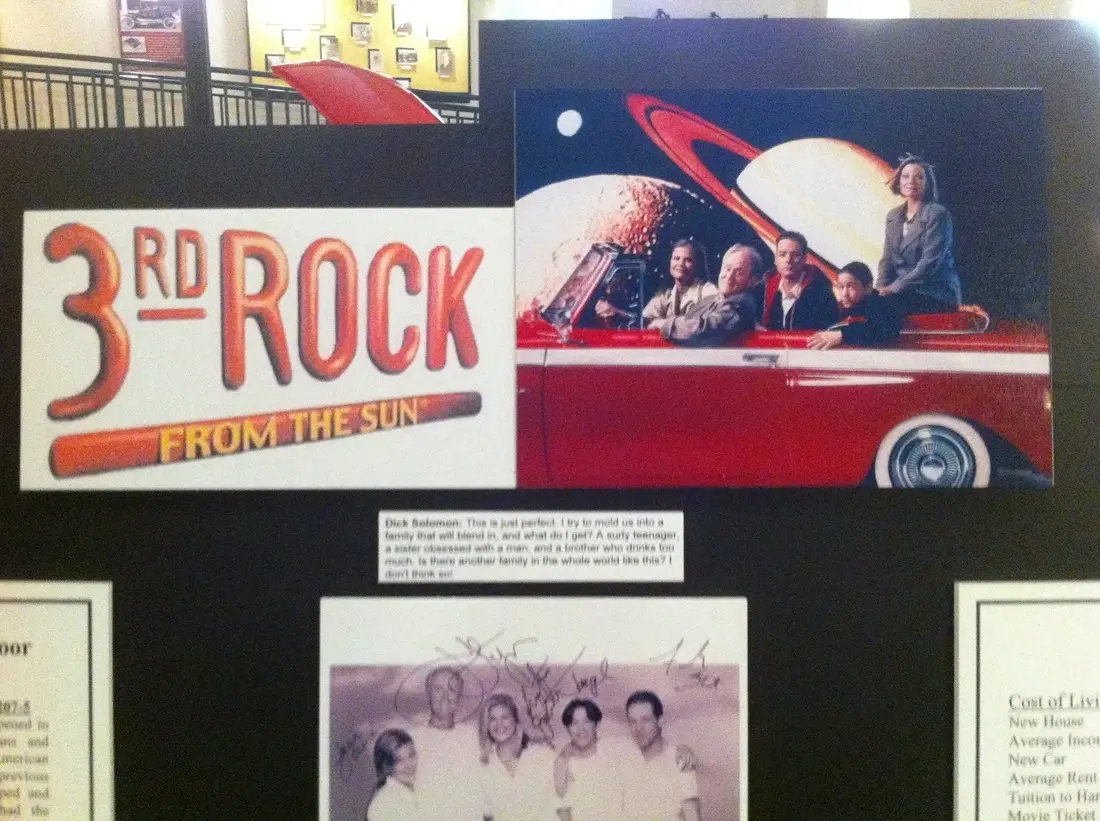
When four aliens arrived on Earth in 1996 with a mission to study the human species, television audiences were given a series that extracted far more from its seemingly simple premise than anyone might have expected. 3rd Rock from the Sun followed Dick, Sally, Harry and Tommy Solomon, who were supposed to observe humans and learn how they functioned. Instead, as they tried to fit into everyday life, they began to discover just how absurd human habits, relationships and social rules could be. The series ran for six seasons and 139 episodes, concluding in 2001, but what it left behind was more than a collection of outrageous situations. Seen from today, 3rd Rock from the Sun also preserves an unexpectedly precise portrait of the mid-1990s - a world in which people still talked on telephones without staring at screens, television programmes were watched at a set time, and the internet was only beginning to reshape everyday life.
Earth, Seen for the First Time
That was the central idea behind the series. The Solomons had no difficulty understanding physics, the universe or technology, yet they encountered almost insurmountable obstacles whenever they had to explain why humans behaved the way they did. Dick Solomon, commander of the expedition and a professor of physics, could lecture perfectly seriously about the cosmos while finding it almost impossible to understand why his colleague Mary Albright did not return his feelings, or why people attached so much importance to social rules they had invented themselves. Sally, meanwhile, was trying to understand femininity, attraction and the behaviour of the sexes; Tommy was an alien of enormous knowledge trapped inside the body of a teenager; and Harry functioned as the unpredictable variable in the entire expedition. The four were more than comic characters. They were outsiders observing a species closely enough to participate in its life, yet distant enough to notice what humans themselves had long stopped seeing.
That perspective gave the series an unusual advantage. When a human being says that something makes no sense, it usually sounds like criticism. When the same observation comes from an alien who has just arrived on Earth, it becomes comedy. The Solomons could not understand why people dressed the way they did, why popularity mattered, why they entered romantic relationships, why they stayed in jobs they disliked or why they spent so much time trying to create a particular impression in the eyes of others. The audience, of course, knew the answers to all of these questions, but that familiarity was precisely what made the situations funny. The series took ordinary human behaviour and held it up in a slightly distorted mirror - familiar enough to recognise, yet strange enough to become funny all over again.
Four Actors, Four Different Routes to the Absurd
John Lithgow turned Dick Solomon into one of his most recognisable television characters, creating a figure who could be brilliant, childish, egotistical and completely lost at the same time. His greatest comic strength was that Dick never realised how funny he was. Every new human situation represented, in his mind, a serious problem requiring a solution, meaning that even the most ordinary conversation could be approached like a scientific experiment. His relationship with Mary Albright, a professor who gradually became aware of just how unusual her colleague was, provided one of the show's central emotional and comic threads. Dick wanted to become human, but he could not understand that humanity could not be mastered simply by learning enough rules. The more important lessons were the ones no book could teach him: uncertainty, intuition, compromise and the ability to surrender to a situation rather than analyse it.
Sally, played by Kristen Johnston, approached many of the same questions from an entirely different direction. As an alien sent to Earth in a female body, she had to navigate a whole system of social expectations that humans rarely stopped to question - from clothing and appearance to relationships with men and attitudes towards her own body. Johnston won two Emmy Awards for the role, and her portrayal of Sally, a warrior trapped inside a body that society interpreted as delicate, remains one of the show's most memorable elements. Tommy offered another reversal of perspective: the oldest member of the expedition found himself trapped in the body of a teenager and forced to deal with school, peers and the familiar problems of adolescence, despite being mentally older than almost everyone around him. Joseph Gordon-Levitt, who would go on to build a successful film career years later, found one of his first major television roles through Tommy. French Stewart, as Harry, pushed the boundaries of absurdity even further, creating a character who often seemed to be only seconds away from losing contact with reality altogether.
The 1990s May Be the Show's Greatest Special Effect
Watching 3rd Rock from the Sun today, some elements can seem almost startlingly old-fashioned. That is precisely what makes them so valuable. The characters have telephones, but they do not carry them everywhere. News arrives through newspapers and television rather than an endless stream of notifications. If someone wants to know something, they cannot simply type a question into a search engine. Information still has a physical geography: you have to go to a library, find a book, ask someone or simply accept that there may not be an immediate answer. Even the way the characters spend their free time belongs to the world before smartphones and social media, when television was one of the few places where millions of people could watch the same thing at the same time.
That makes the series an accidental portrait of its era. It was never trying to document the 1990s or present them as a historical period, and that is precisely why it captured them so naturally. Apartments, offices, cars, clothes, television sets, advertisements, patterns of communication and social relationships now carry almost as much weight as the plot itself. A viewer who grew up with the series may recognise a particular telephone or interior before remembering a specific episode. The nostalgia is not confined to the characters. It lives in an entire world that disappeared almost without anyone noticing.
Humour with More Than One Layer
On the surface, the series was a playful sitcom. Beneath that, it was able to explore ideas that were anything but trivial. Through the perspective of outsiders, it could poke fun at academia, the media, consumer habits, politics, sexuality, relationships between men and women, and the human desire to conform to other people's expectations. The aliens had the luxury of being brutally honest because they had no reason to understand why certain subjects were supposed to be uncomfortable or why anyone should behave in a particular way simply because that was how things were done.
The world has changed considerably since then, but the underlying questions have barely moved. People still want to be accepted, still search for love, compare themselves with others, worry about work and status, and try to make sense of their own lives. Only the tools have changed. The Solomons would probably have a much harder time understanding why people spend hours watching other people's lives on their phones, why they photograph almost every moment or how someone can have thousands of virtual connections while feeling profoundly alone. Their original mission would be no less strange today - it would simply give them considerably more material to study.
The Last Great Shared Television World
The series arrived at a time when television could still create a shared experience without the help of algorithms. An episode did not need to go viral, have its best moments extracted into short clips or become the subject of social-media discussion to enter everyday conversation. People watched when it was scheduled, then waited for the next episode. That waiting may seem like a limitation now, but it created a different relationship with television. Characters entered viewers' lives gradually, and a series had time to make them familiar.
The energy of 3rd Rock from the Sun came from exaggeration, physical comedy and a willingness to throw ordinary situations completely off balance, rather than from the realism pursued by many other shows of its era. Beneath all that absurdity, however, was a remarkably simple idea: people rarely notice how strange their own customs are until someone encounters them for the first time.
Perhaps that is why, three decades later, the series feels like more than a return to a television hit from the 1990s. It also offers a glimpse of a time when the world seemed slower, television occupied a more central place in everyday life, and ordinary things were still familiar enough to be taken for granted. The Solomons came to Earth to study humanity. Their unexpected legacy is that, in the process, they preserved a portrait of what we looked like ourselves - before we realised just how profoundly our world was about to change.