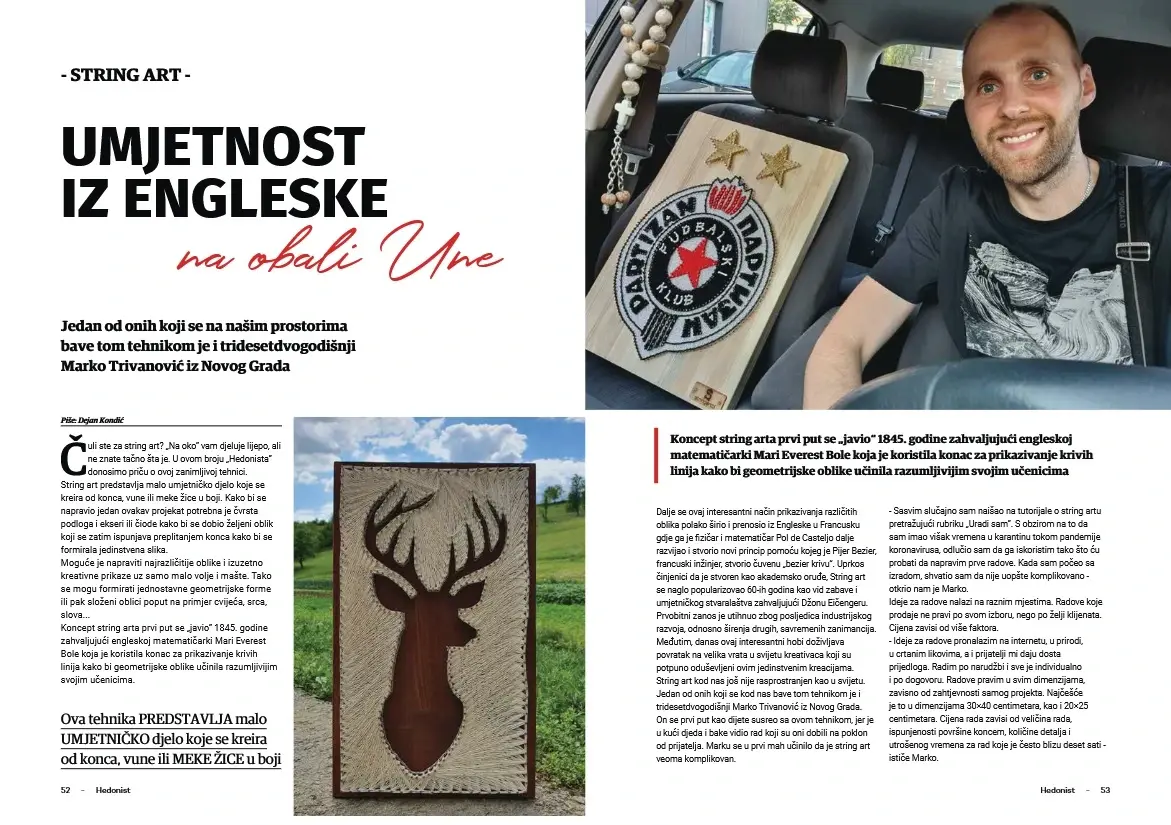
String Art: An Art Form from England on the Banks of the Una
![[object Object]](https://api.hedonistmagazine.net/storage/images/2026/03/62577086-c213-47dc-97b1-e394c4dbe0fc.webp)
Have you heard of string art? At first glance, it looks beautiful, but you may not be entirely sure what it is. HEDONIST magazine brings you the story behind this fascinating technique. String art is a small work of art created using thread, yarn, or soft colored wire. To create one of these pieces, you need a solid base along with nails or pins to outline the desired shape. The design is then filled in by weaving the thread, resulting in a unique and visually striking composition.
Editor’s Note: This article is part of the HEDONIST archive and was originally published in 2021, in the seventh print edition of the magazine.
It is possible to create a wide variety of shapes and highly creative designs with just a bit of will and imagination. From simple geometric forms to more complex figures such as flowers, hearts, or letters, the possibilities are endless. The concept of string art first appeared in 1845, thanks to the English mathematician Mary Everest Boole, who used thread to illustrate curved lines and make geometric shapes easier for her students to understand.

Over time, this interesting method of visualizing different forms gradually spread from England to France, where physicist and mathematician Paul de Casteljau further developed it. His work later enabled French engineer Pierre Bézier to create the famous Bézier curve. Although originally conceived as an academic tool, string art experienced a surge in popularity during the 1960s as a form of entertainment and artistic expression, largely thanks to John Eichinger.
The initial enthusiasm eventually faded due to industrial development and the rise of other modern forms of entertainment. However, today this fascinating hobby is making a strong comeback among creatives who are once again captivated by its unique aesthetic.
In our region, string art is still not as widespread as it is globally. One of those practicing this technique locally is Marko Trivanović from Novi Grad. He first encountered string art as a child, when he saw a piece in his grandparents’ home that they had received as a gift from a friend. At first, it seemed quite complicated to him.

“Quite by chance, I came across string art tutorials while browsing ‘DIY’ content. Since I had extra time during the COVID-19 lockdown, I decided to use it to try making my first pieces. Once I started, I realized it wasn’t complicated at all,” Marko told us.
He draws inspiration for his work from many sources. The pieces he sells are not made at his discretion but according to clients’ wishes, and the price depends on several factors.
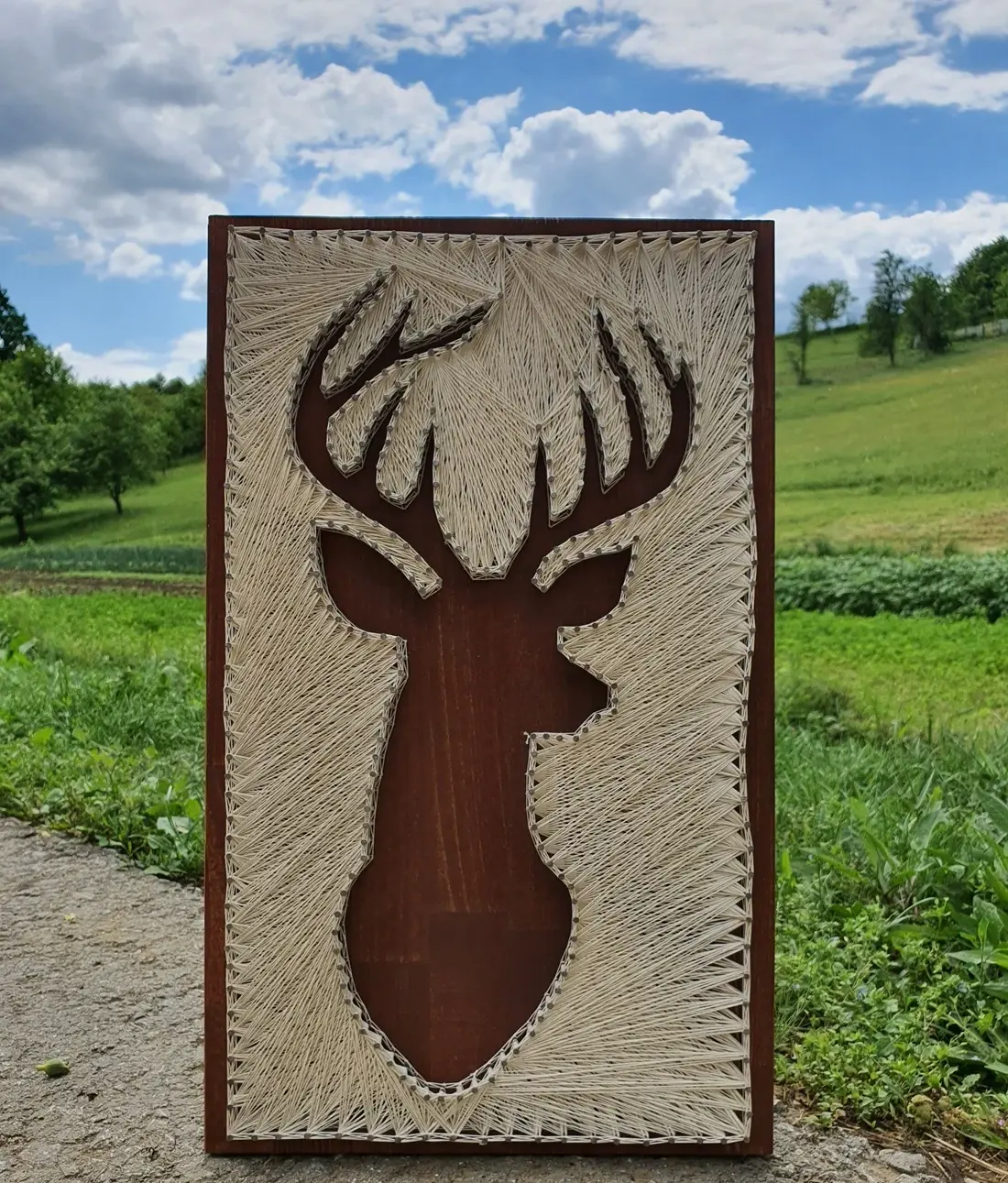
“I get ideas from the internet, nature, animated characters, and my friends often suggest concepts as well. I work on commission, and everything is individual and agreed upon in advance. I create pieces in various sizes, depending on the complexity of the project - most often 30×40 cm or 20×25 cm. The price depends on the size, the density of the thread work, the level of detail, and the time required, which is often close to ten hours,” Marko explains.
- Written by: Dejan Kondić / HEDONIST
- Originally published in HEDONIST Magazine, Issue 07, 2021