
Free Time, Expensive Watches: Geneva and the $100 Million Auction

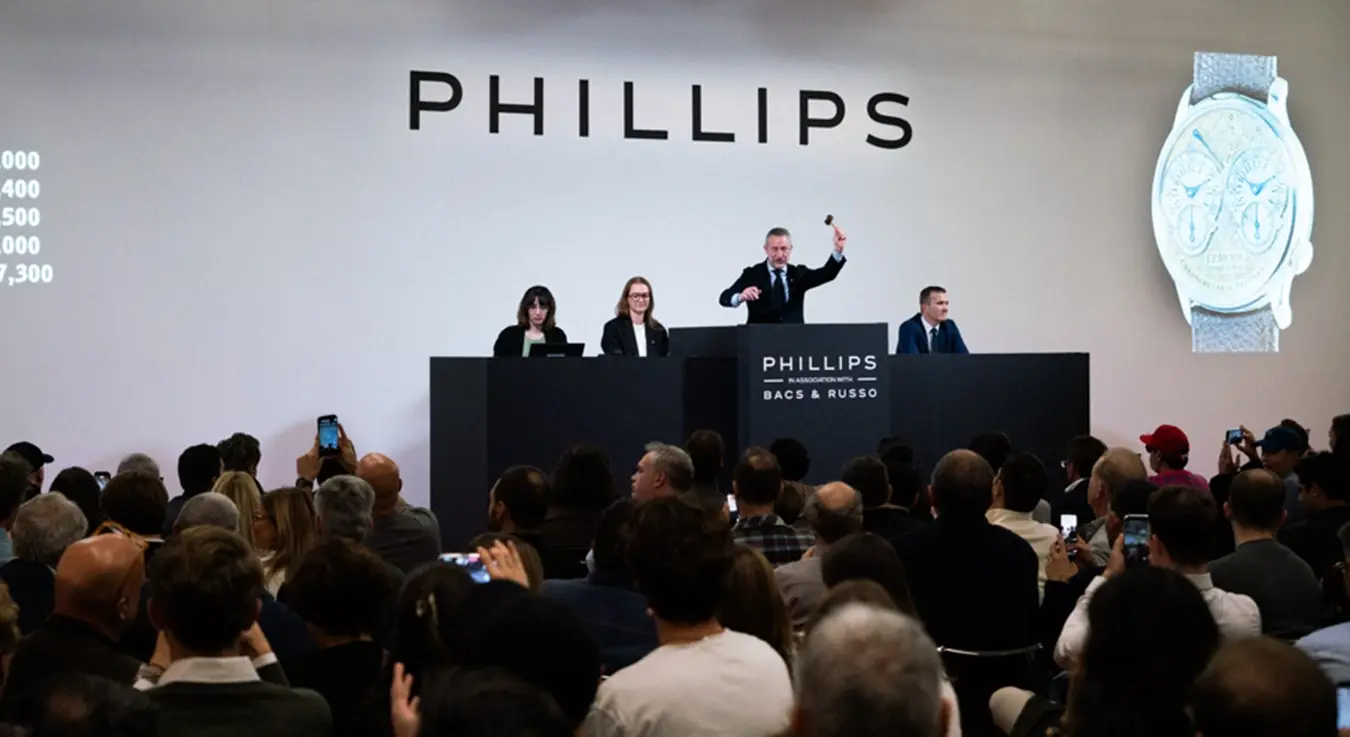
Last weekend, buyers took all 217 lots in a Geneva auction room, generating $112.3 million, with the most expensive watch selling for about $10.6 million. The question isn't how much money changed hands, but what people are buying when the time is already displayed on the phone in their pocket.
Geneva’s autumn auction week began much like any other November: auction houses, hotel ballrooms and auctioneer Aurel Bacs taking his place at the rostrum. It ended with the first live watch auction in history to surpass $100 million. Over two days, on November 7 and 8, Phillips generated CHF 92 million, equivalent to $112.3 million. All 217 lots were sold, 24 world records were set, and 2,121 registered bidders from 69 countries took part. The average lot fetched more than $500,000.
The Numbers Left Behind After the Room Emptied
Phillips' previous record had stood for just six months. Seventeen lots exceeded CHF 1 million. On November 9, Christie's achieved CHF 47.8 million, the highest total in the history of its watch department and more than double its result from the previous November (CHF 21.6 million). Sotheby's added more than $32 million through its auctions on November 8 and 9, bringing the combined three-day total for the three houses to $203 million. All quoted prices include the auction houses' buyer's premiums, meaning the actual hammer prices were somewhat lower.
Three Lots Worth Remembering
At the top of the results was a platinum F.P. Journe Chronomètre à Résonance “Régence”, featuring a hand-engraved rose-gold dial. It sold for CHF 8,680,500 (approximately $10.6 million), setting a record for the watchmaker. It also marked the fifth consecutive Phillips auction event at which a watch had sold for more than $10 million.
Close behind was a 1945 Patek Philippe Ref. 1436, a split-seconds chronograph in stainless steel. It is one of only two known examples to retain both its original case and dial. The watch fetched CHF 6,267,000 ($7.6 million), setting a record for any split-seconds chronograph.
The most unusual lot was not a wristwatch at all. Cartier's 1924 Portico Mystery Clock No. 4 is one of only six known Portico clocks and the only one featuring a hexagonal rock-crystal dial. It sold for CHF 4,815,000 ($5.87 million), setting a record for any Cartier timepiece sold at auction. The clock had not appeared on the auction market since 1996.
The Man Behind a Third of the Auction
Thirteen watches by François-Paul Journe generated CHF 31.8 million for Phillips – more than a third of the auction's total turnover, despite accounting for only around six per cent of the lots. The Tokyo Boutique Résonance sold for approximately $7.5 million, while the diamond-set Vagabondage III fetched around $6.2 million. Both results established records for their respective models.
At Christie's, a rose-gold set comprising the Vagabondage I, II and III, with matching serial numbers, was acquired by a private collector for CHF 6.71 million.
One of the most compelling stories involved watches from the collection of Michael Schumacher. François-Paul Journe's complete five-watch Ruthenium collection, bearing the number 92/99, was offered at Christie's as five separate lots. The Tourbillon Souverain and Résonance each sold for CHF 1,536,000. According to WatchPro, those same two watches had been sold by the same auction house in May 2024 for CHF 642,600 and CHF 390,600 respectively – representing increases of approximately 2.4 and 3.9 times in just two and a half years.
George Daniels also had his moment. His 2001 Millennium in yellow gold, one of only 48 examples, sold at Sotheby's for the same figure: CHF 1,536,000, more than five times its low estimate of CHF 300,000.
Who Is Buying - and What Are They Paying For?
Christie's reports that 40 per cent of registered participants were Millennials or members of Generation Z, while 19 per cent of all bidders were new to the auction house.
The results suggest that buyers are paying for provenance and narrative: Schumacher's ownership, a set with matching serial numbers, or a watch that has never changed hands. The Rolex Ref. 6062 “Stelline”, recently discovered in Japan and acquired from its original owner, sold for CHF 2.33 million. A watch with a history is worth more than one that simply keeps time.
A Sober Note to End On
It is not all about growth without limits. WatchPro suggests that, once the excitement subsides, collectors and industry specialists may conclude that prices for the most sought-after lots, when compared with similar examples, have remained broadly in line with autumn 2025 and spring 2026 levels. The record-breaking auction totals are largely the result of a greater number of exceptional watches being offered for sale.
The market may, in fact, have reached its peak, the publication suggests.
Phillips, however, is already looking ahead. Its next auctions are scheduled for November 21 and 22 in Hong Kong, followed by December 5 and 6 in New York.
And the mechanical watch will continue to tell the time less accurately than the phone in your pocket. Apparently, that is the one detail nobody seems to mind.
Tags
Related articles

The Watch That Went to the Moon: How the Omega Speedmaster Became a Legend
On July 20, 1969, more than 600 million people around the world sat in front of their television sets, waiting for a moment no previous generation had ever imagined possible. The black-and-white images were grainy, the signal faded in and out, and voices from space arrived through bursts of static and interference. Yet no one looked away. Humanity was about to witness its first footsteps on another world.
Quiet Luxury on the Wrist: Watches Recognized Only by True Connoisseurs
There comes a moment when luxury stops being a loud display of status and becomes something far more subtle. Something that does not ask for attention, yet still receives it. In the worlds of fashion, automobiles, and interior design, this trend has for years been known as “quiet luxury” - an aesthetic of discreet sophistication in which quality speaks louder than logos.