

When Mysteries Lose Their Magic: Stories Science Eventually Explained

![[object Object]](https://api.hedonistmagazine.net/storage/images/2026/05/4638068e-0c4b-4fc1-bd81-f3bee5252f3b.webp)
There is something irresistible about mysteries. They invite us to imagine, to doubt, to believe in the unknown. The world has always been full of stories that defy logic - ships without crews, signals from space, unexplained sounds from the depths of the ocean. And perhaps that is exactly why we love them: they leave room for wonder. But what happens when a mystery finds an answer?
Does it lose its magic - or become even more fascinating?
The Signal That Could Have Changed Everything
In 1977, at the Ohio State University observatory in the United States, a powerful radio signal from deep space was recorded, and scientists could not hide their excitement. It was short, clear, and unusually intense - so much so that one researcher simply wrote “Wow!” next to the printout. For years, it was speculated to be evidence of extraterrestrial intelligence.

Decades later, the theories became more grounded. The most likely explanation points to natural sources - clouds of hydrogen associated with the passage of comets through space.
It was not a greeting from afar. It was a reminder of how much we still do not understand about nature.
A Ship Without a Crew, But Not Without Answers
One of the most famous maritime mysteries was the abandoned ship Mary Celeste, found in the Atlantic Ocean in the late 19th century. The cargo was intact, personal belongings were still in place - but the crew was gone.
No signs of struggle. No obvious tragedy.

Only later, through analysis of the cargo and the ship’s conditions, did a plausible reconstruction emerge. Alcohol vapors being transported may have created pressure and triggered fear of an explosion. The crew likely abandoned the ship temporarily - but, due to harsh conditions, never managed to return.
The mystery did not disappear entirely. But it gained a human face - imperfect and vulnerable.
The Man Without a Name Who Finally Got One
On an Australian beach, the body of a man was found with no identity. No documents, no clear cause of death, with clues that felt more like a spy story than reality.
For decades, he remained known only as “the unknown man.”

Only in the modern era, thanks to advances in DNA analysis, was his identity finally revealed - Carl “Charles” Webb, an engineer from Melbourne. A mystery that lasted more than half a century was solved not by intuition, but by science.
Behind the enigma, there was no conspiracy - just an ordinary, forgotten life.
The Triangle That Stopped Being Supernatural
Disappearances of ships and aircraft in the area known as the Bermuda Triangle, a region of the Atlantic Ocean between Bermuda, Florida, and Puerto Rico, fueled public imagination for decades. Stories of aircraft vanishing without a trace, compasses losing direction, and ships disappearing without distress calls created a reputation of a place where the laws of physics did not apply.
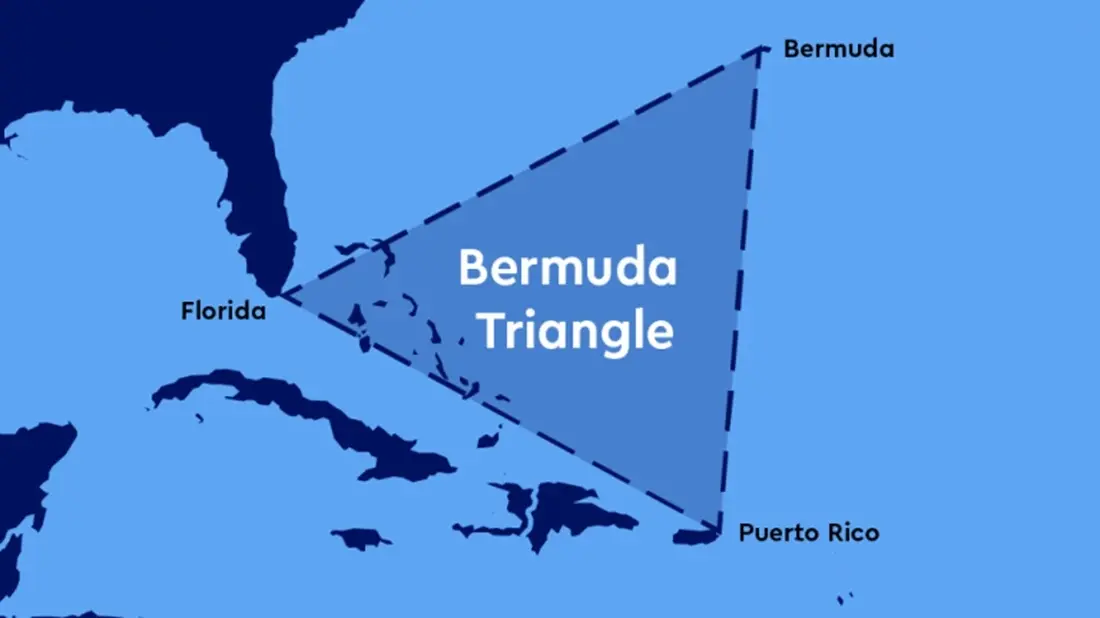
Today, most of these cases have rational explanations. A combination of powerful storms, unpredictable ocean currents such as the Gulf Stream, navigational errors, and natural phenomena like sudden releases of methane gas from the ocean floor is enough to explain what once seemed paranormal.
The mystery was never in the place, but in our understanding.
A Sound That Did Not Come From a Monster
In the late 1990s, the United States National Oceanic and Atmospheric Administration recorded an unusual, extremely powerful underwater signal in the South Pacific. The sound, later named “Bloop,” was so intense that it sparked theories about unknown, gigantic sea creatures.
It was perfect material for legends.
Further research, however, showed that it was a natural phenomenon - the sound of large ice masses, or icebergs, cracking and shifting. When they break apart, they can produce powerful acoustic waves capable of traveling thousands of kilometers.
There was no monster. Just a changing planet.
The Lost City That Was Never Truly Lost
The story of the ancient city of Machu Picchu, hidden among the Andes in Peru, long sounded like an adventure myth. When it was introduced to the world in the early 20th century by American explorer Hiram Bingham, it seemed as though a lost civilization had been discovered.

But the truth was more nuanced.
The city was never entirely unknown - local people were aware of its existence and used the surrounding area. What was truly “discovered” was the perspective of the rest of the world.
Sometimes, a mystery does not lie in disappearance - but in who is looking.
Do Mysteries Ever Truly Disappear?
When science explains, it often feels as though the mystery loses its charm. Uncertainty fades, along with the sense that something exists beyond our understanding.
But perhaps that is the wrong way to see it.
Because every explanation opens new questions. Every solved enigma shifts the boundary of the unknown, but never erases it. The world does not become less mysterious - only the mysteries change.
And perhaps that is their true value. Not in remaining unsolved, but in pushing us to search for answers.