

What Would Squid Game Look Like If It Were Filmed in Ex-Yugoslavia?
![[object Object]](https://api.hedonistmagazine.net/storage/images/2026/03/53822cdb-a9eb-4861-bff3-fc0f479342ef.webp)
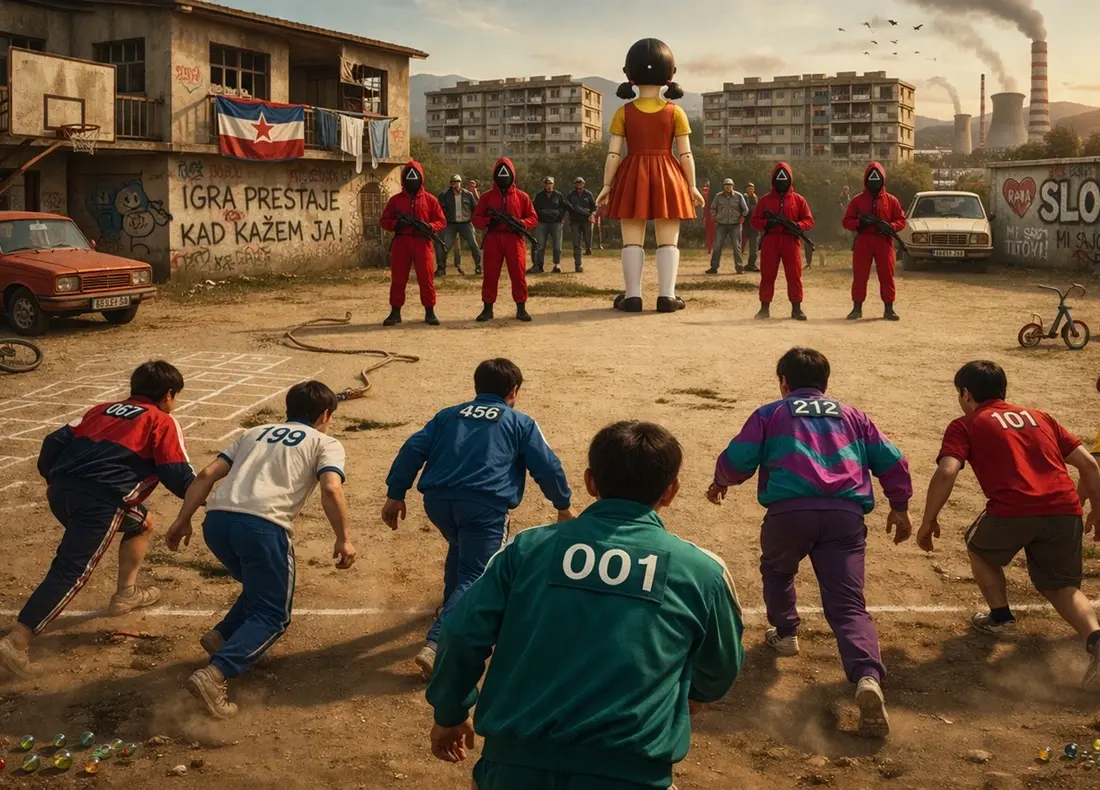
If this global phenomenon were set in the former Yugoslavia, the scenery would change - but the essence would remain the same: tension, strategy, and childhood games that suddenly no longer feel innocent. Instead of futuristic arenas, we’d see schoolyards, concrete playgrounds, grassy fields behind apartment blocks, and abandoned halls. And instead of Korean games, familiar childhood favorites.
Here’s how it might look:
1. Between Two Fires
A classic everyone remembers. Two teams, a ball, and the space in between.
In this version, the field would be enclosed, and the rules would be stricter - speed, reflexes, and strategy would decide everything.
This game would perfectly convey pressure: you are always a target, with very little room for error.
2. Elastics (Jump Rope Game)
At first glance, it seems harmless - but only until it begins.
A sequence of jumps that requires precision, rhythm, and focus.
In a “Squid Game” version, the difficulty would increase round by round. Those who lose focus are out. Simple, yet mentally exhausting.
3. Hopscotch
Chalk, concrete, and balance.
In this scenario, the layout would be more complex and the pace faster.
One wrong step, one bad estimate - and the game is over.
A perfect mix of precision and tension.
4. Freeze Tag
A game already filled with suspense.
One player chases, others run - but once you’re “frozen,” you must stand still.
In this version, the space would be limited, and saving others would come with a serious risk.
Who helps others, and who plays only for themselves?
5. Marbles
Silence, focus, and precision.
At first glance, the calmest game - but perhaps the most intense.
Here, every move carries weight.
No running, no hiding - just concentration and a steady hand.
6. Hide and Seek
Setting: an abandoned factory or school.
One counts, the others hide.
But here, hiding isn’t just a game - it’s a test of patience, judgment, and courage.
When do you move? When do you stay hidden?
7. “Emperor, Emperor, How Many Steps?”
One of the most suspenseful childhood games, even if it doesn’t seem so at first.
One player is the “emperor,” standing with their back turned, while others ask from a distance how many steps they can take. The answer determines the number and type of steps - small, large, jumps - until someone gets close enough to try to tag them.
In a Squid Game-style version, this game would take on a completely new dimension.
The tension wouldn’t come only from movement, but from the emperor’s decisions - allowing progress or suddenly turning the game against the players.
Every step would be a calculation.
Every question is a risk.
And the moment the emperor turns around would be the moment everything stops.
The Aesthetic of the Ex-Yu Version
Instead of sterile minimalism, the visual identity would be defined by:
faded graffiti
concrete blocks
school benches and rusted structures
tracksuits, sneakers, and a retro 90s vibe
The music? A mix of children’s counting rhymes and the faint sound of a radio playing from a neighboring apartment.