

Surfing Volcanic Ash: Adrenaline on the Slopes of Cerro Negro
![[object Object]](https://api.hedonistmagazine.net/storage/images/2026/08/f7edbeda-2de8-41b8-a19f-9ab0dbbd4f6d.webp)
In 2004, Daryn Webb stood at the summit of Cerro Negro looking for a faster way down. He'd already tried a surfboard. He'd tried a snowboard. When neither worked the way he'd hoped, the story still goes around León that he even tried a refrigerator door.
It wasn't until he cobbled together a crude, sit-down board from plywood and a strip of laminate that he found something that could survive a run down the volcano's black slope. That, more or less by accident, is how volcano boarding was born - a sport that now draws thrill-seekers from around the world to one of the strangest places on Earth where it can even be attempted.
There's no snow on one of Central America's youngest volcanoes. No waves, either, and nothing resembling a groomed ski run. And yet Cerro Negro, in Nicaragua, has welcomed more than 17,000 visitors down its slopes since the sport was invented - turning what was once a raw geological force into one of the most sought-after adrenaline rushes on the planet.
A volcano that's only 175 years old
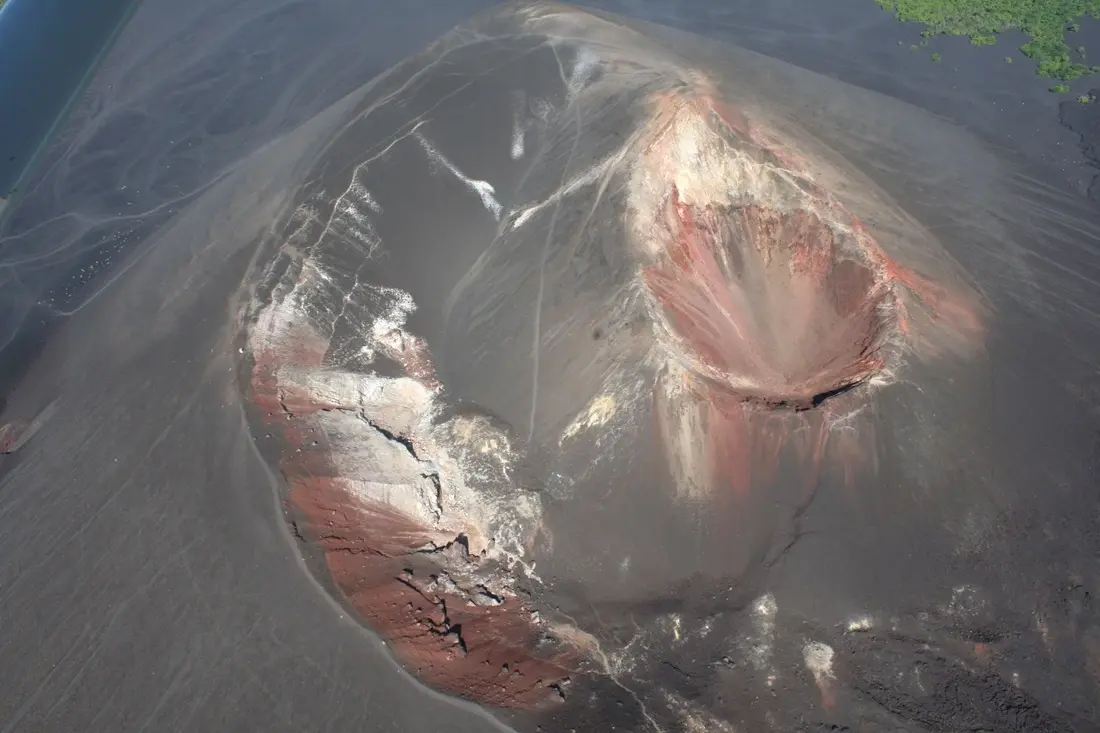
Cerro Negro sits a few kilometers outside the city of León and ranks among the youngest volcanoes in Central America. It was born in 1850, and successive eruptions have since shaped it into a 728-meter cone almost entirely stripped of vegetation. Its last major eruption was recorded in 1999, which still classifies it as active, even though smoke is a rare sight these days.
That particular combination - a young volcano, a punishing 41-degree slope, and ground composed of loose, fine ash - has created conditions found nowhere else on the planet. As far as the available record shows, Cerro Negro remains the only place in the world where volcano boarding operates as an organized tourist activity.
Forty seconds that justify the climb
Getting to the adrenaline, somewhat paradoxically, means walking there first. The climb to the summit takes anywhere from forty-five minutes to an hour, board slung over one shoulder, across terrain that looks closer to a lunar surface than anything tropical. The view widens as you climb - black volcanic fields giving way to Nicaragua's green plains in the distance - until you reach the crater's rim, where the landscape turns almost abstract.
The descent itself lasts, by most accounts, around forty seconds. That's enough time to hit speeds that, for more experienced riders, top 70 kilometers per hour, while the official record for the sport - held by an Israeli rider - sits at 87 kilometers per hour. For context, French cyclist Éric Barone reached 172 kilometers per hour on the same slope in 2002, on a bicycle, before it snapped in half beneath him - a record that stood until it was broken in 2011.
Speed comes down to gradient, technique, and, as the guides who walk these groups up and down the volcano every day will admit, how much risk a rider is willing to take on. Volcanic ash, unlike snow, doesn't forgive mistakes - which is why a protective suit, goggles, and sturdy boots aren't optional extras, but the price of admission.
Geology turned into adventure
What was once a threat is now the reason people come. The slope's black surface isn't an aesthetic choice of nature - it's the direct residue of material deposited by eruptions over the past hundred and seventy years. At Cerro Negro, geology and modern adventure culture collide in a way that's rare and hard to replicate elsewhere: a place a geologist would call hazardous has become, for the tourism industry, a fixture on Central America's adventure circuit.
Nicaraguan tourism, after decades of slow growth following the internal conflicts of the 1980s, has finally begun to recover over the past twenty years, and Cerro Negro is one of the few reasons travelers deliberately choose this particular destination - many, by their own account, build an entire trip around this single descent.
Adrenaline with a view you won't forget
Cerro Negro isn't a destination for anyone looking for a conventional brush with nature. Its beauty is raw, dark, and almost minimalist - which is exactly why it leaves an impression that outlasts the forty seconds it takes to earn it.
It needs no artificial structure, no purpose-built course, no dramatic infrastructure. A volcano, a board, gravity, and a few seconds of nerve are enough.
Which is, in the end, the best definition of the sport: it didn't invent the landscape. It simply learned how to use it.
- Written by Ognjen Tešić / HEDONIST